
|

|
 あきざきクロッカス (秋咲きクロッカス) |
[Index]
[Back]
|
|
|
    |
|

|
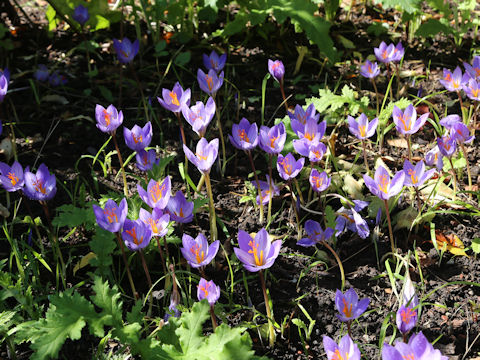
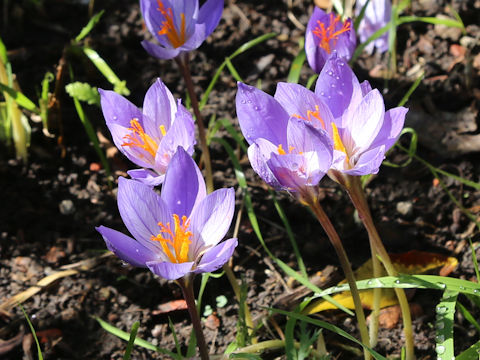
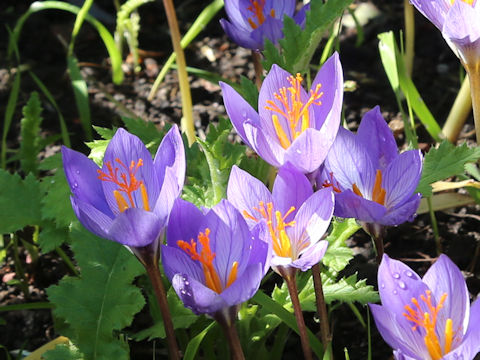
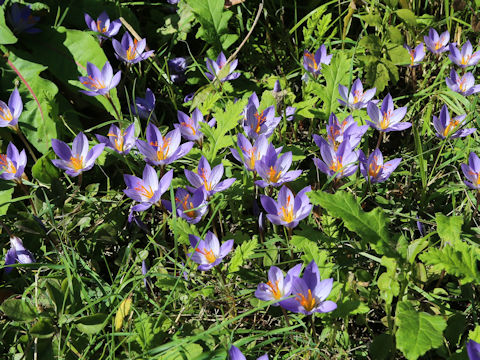
ヨーロッパのブルガリアからトルコ、コーカサス地方、イラン北部に分布しています。落葉樹林や草原、牧草地、潅木帯などに生え、高さは10~15センチになります。10月から11月ごろ、葉が出る前に、地面から花茎を伸ばしてライラック色の花を咲かせます。花弁には濃い紫色の繊細な縦縞があります。雄しべの数は3個です。秋に花が咲いた後、冬から春にかけて葉が伸び、初夏に枯れて休眠期に入ります。観賞用植物として栽培されています。英語名は19世紀はじめにコーカサス地方やクリミア半島の植物を調査した、ドイツ生まれの植物学者「フリードリヒ・ビーベルシュタイン(1768-1826)」に因みます。 韓国語では「カウルクロコス(가을크로커스)」です。これは「秋(カウル: 가을)」+「クロッカス(クロコス: 크로커스)」の合成語です。 |
|
|
アヤメ科クロッカス属の多年草で、学名は Crocus speciosus。英名は Bieberstein's crocus。 |
|
|
The Bieberstein's crocus (Crocus speciosus) belongs to Iridaceae (the Iris family). It is a perennial herb that is native from Bulgaria in Europe to Turkey, the Caucasus region, and northern Iran. It grows in deciduous forests, grasslands, meadows, and shrublands, reaching a height of 10 to 15 cm. From around October to November, before the leaves emerge, it extends flower stalks from the ground and produces lilac-colored flowers. The petals feature delicate, dark purple vertical stripes. It has three stamens. After flowering in the fall, the leaves grow from winter through spring, and the plant withers in early summer, entering a dormant period. It is cultivated as an ornamental plant. Its English name is derived from the German-born botanist Friedrich Bieberstein (1768-1826), who surveyed plants in the Caucasus region and the Crimean Peninsula in the early 19th century. In Korean, it's called "ka-eul-keu-ro-keo-seu" (가을크로커스). This is a compound word consisting of "autumn" (ka-eul: 가을) + "crocus" (keu-ro-keo-seu: 크로커스). |
|
|
北海道札幌市中央区「北海道大学植物園」にて、2026年09月30日撮影。 |
|
|

|
Shu Suehiro shu@botanic.jp |
|