

|
 あきののげし (秋の野芥子) |
|
|
                   |
|

|
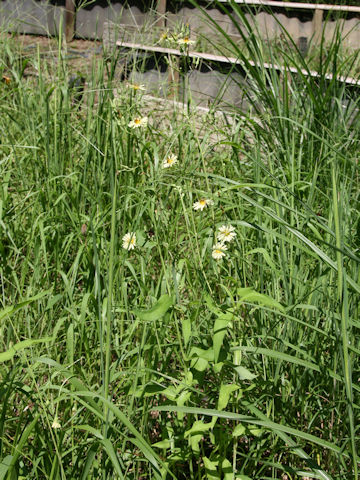
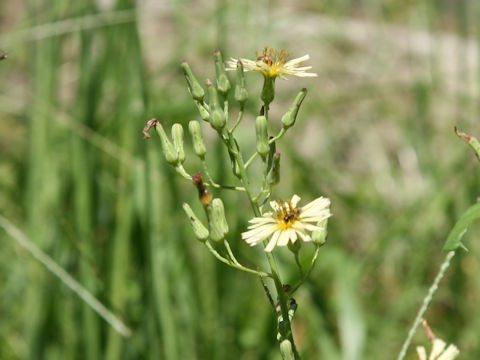
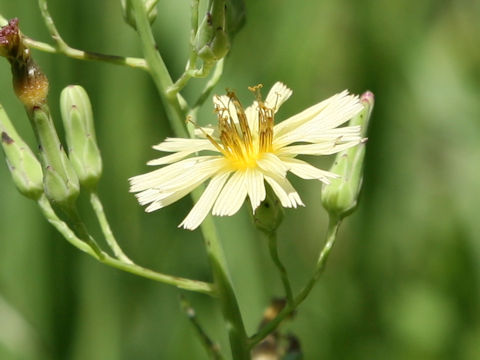
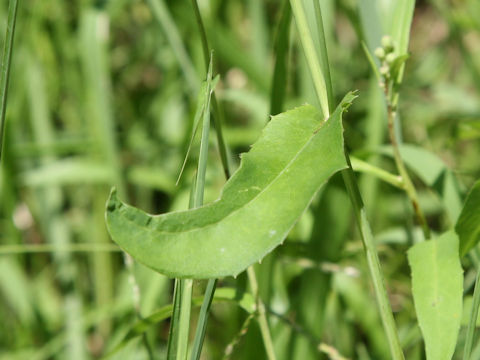
わが国の各地をはじめ、東アジアや東南アジアに広く分布しています。また人の住むところにしか生えていないことから、古い時代に大陸から帰化したものと考えられています。高さは60~200センチになり、下部の葉は羽状に裂けて互生します。8月から11月ごろ、茎の上部に大きな円錐花序をつけ、淡い黄白色の花を咲かせます。昼間に開いて夕方には萎みます。和名は「のげし」に似ていて秋に咲くことから。台湾華語では「鵝仔草」、中国語では「翅果菊(chi guo ju)」と呼ばれます。 韓国語では「ワンゴドゥルペギ(왕고들빼기)」です。これは「王(ワン: 왕)」+「イヌヤクシソウ(ゴドゥルペギ: 고들빼기)」の合成語です。韓国では、春や秋の山菜として若い葉や根をキムチやムチム(和え物)にして、独特のほろ苦さを楽しみます。 |
|
|
キク科アキノノゲシ属の一年草で、学名は Lactuca indica (syn. Pterocypsela indica)。英名は Indian lettuce。 |
|
|
The Indian lettuce (Lactuca indic) belongs to Asteraceae (the Aster family). It is an annual herb that is widely distributed in various parts of Japan, East Asia and Southeast Asia. Moreover, it is thought that it was naturalized from the Asian continent in old age because it grows only where people live. It grows up to 60-200 cm, and the lower leaves are divided into pinnate lobes and arranged in alternate. The large panicle is borne and the pale yellowish white flowers will bloom from August to November. The flowers open in the daytime and wither in the evening. The Japanese name is due to being similar to "Nogeshi (Sonchus oleraceus)" and blooming in fall. In Taiwanese, it is called "鵝仔草", and in Chinese, it is called "翅果菊" (chi guo ju). In Korean, it's called "wang-co-deul-ppae-gi" (왕고들빼기). This is a compound ward consisting of "king" (wang: 왕) and "Sonchus-leaf false hawksbeard" (co-deul-ppae-gi: 고들빼기). In South Korea, the young leaves and roots are used as spring and fall mountain vegetables, often prepared as "kimchi" or "mu-chim" (dressed vegetables), where people enjoy their distinctive, slightly bitter flavor. |
|
|
[上・中1・中4~5] 長野県伊那市長谷黒河内にて、2006年08月24日撮影。 [中2] 長野県麻績村麻にて、2005年08月29日撮影。 [中3] 大阪府交野市星田「ほしだ園地」にて、2006年10月13日撮影。 [中6~中8] 山形県小国町玉川中里にて、2017年09月21日撮影。 [中9・中10] 山形県小国町小玉川にて、2018年08月19日撮影。 [中11~中14] 山形県小国町玉川にて、2019年10月07日撮影。 [中15~17・下] 宮城県仙台市泉区「高森東公園」にて、2024年09月17日撮影。 |
|
|

|
Shu Suehiro shu@botanic.jp |