
|

|
 アルタリだいこん (アルタリ大根)
|
[Index]
[Back]
|
|
|
     |
|

|
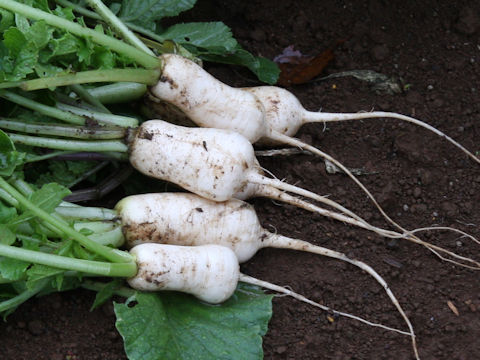
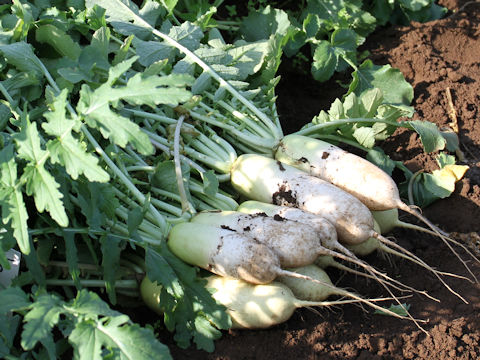
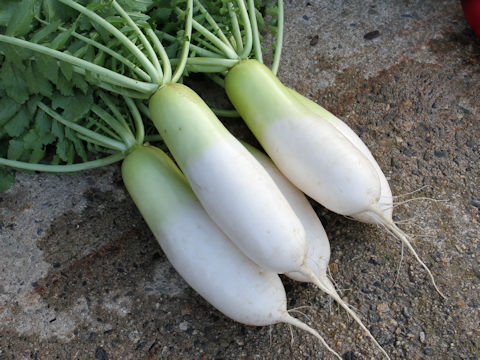
中国大根は、華北型・華南型・華北小大根群の三つの群に大別されます。華北小大根群は、華北(淮河以北)から東北地方、朝鮮半島、中国西部の高原地帯に分布していて、ヨーロッパ大根とも関連のある品種群です。その華北小大根群の代表的品種にアルタリ大根があります。 アルタリ大根は、短根系で小さく、肉質が緻密という特徴があります。一般的には、根径5cmくらい根長10cmくらいで尻部がふくらむ独特な形をしています。改良品種もあり、だるま大根や中型アルタリ大根などが有名です。 韓国では、アルタリ大根を丸ごと、または縦に割ってヤンニョム(タレ)で漬け込んだアルタリ(チョンガク)キムチが代表的な大根キムチとなっています。カクテキよりも細長く、葉が付いていて、シャキシャキとした食感と爽やかな辛味が特徴です。 韓国語では「アルタリム(알타리무)」または「チョンガクム(총각무)」です。これは「アルタリ(알타리)」または「チョンガッ(總角: 총각김)」+「大根(ム: 무)」の合成語です。「チョクガッ」は「未婚の男性」や「独身男性」という意味で、もともとは昔の朝鮮半島などで、子どもや未婚の若者が髪を角(つの)のように結い上げていた髪型に由来しています。(日本でも朝鮮語からの借用語で、チョンガーと呼ばれます。) 写真上・中1の品種は、チャームアルタリ 中2は、サンシャインアルタリ 中3・下は、中型アルタリ(中原種苗) |
|
|
アブラナ科ダイコン属の一年草で、学名は Raphanus sativus var. hortensis (syn. Raphanus sativus var. longipinnatus)。英名は Altari radish。 |
|
|
Chinese radishes are broadly classified into three groups: the North China type, the South China type, and the North China small radish group. The North China small radish group is distributed from North China (north of the Huai River) to the Northeast China, the Korean Peninsula, and the highland areas of western China, and is a group of varieties related to European radishes. A representative variety of this North China small radish group is the Altari radish. Altari radishes are characterized by their short roots, small size, and dense flesh. Generally, they have a unique shape with a root diameter of about 5 cm, a length of about 10 cm, and a bulbous base. There are also improved varieties, with the Daruma radish and medium-sized Altari radish being particularly well-known. In Korea, altari kimchi-made by marinating whole altari radishes or radishes split lengthwise in a special sauce (yangnyeom)-is the most representative type of radish kimchi. It is longer and slimmer than kkakdugi, retains its leaves, and is characterized by a crisp texture and a refreshing spiciness. In Korean, it is called "al-ta-ri-mu" (알타리무) or "chon-ggak-mu" (총각무). This is a compound word formed from "altari" (알타리) or "chon-ggak" (총각) plus "daikon" (mu: 무). "chon-ggak" means "unmarried man" or "bachelor", and originally derives from a hairstyle common in ancient times on the Korean Peninsula, where children and unmarried youths would tie their hair up into a style resembling horns. (In Japan, too, it is known as "chongga", a loanword from the Korean language. |
|
|
[上・中1] 千葉県香取市大角にて、2010年11月18日撮影。 [中2] 同上にて、2012年11月02日撮影。 [中3] 同上にて、2015年11月11日撮影。 [下] 山形県小国町小玉川にて、2018年11月14日撮影。 |
|
|

|
Shu Suehiro shu@botanic.jp
|
|