
|

|
 あまみえびね (奄美海老根)
|
[Index]
[Back]
|
|
|
    |
|

|
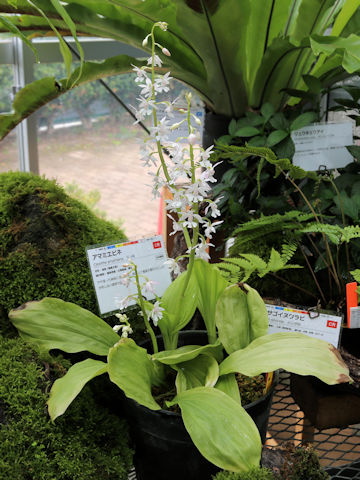
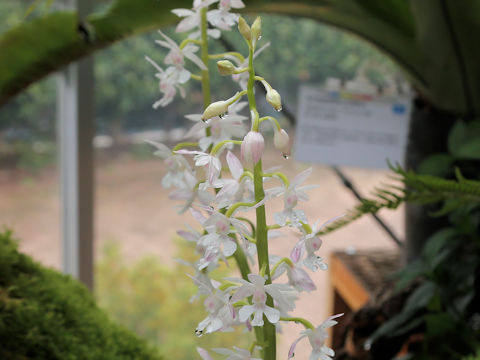
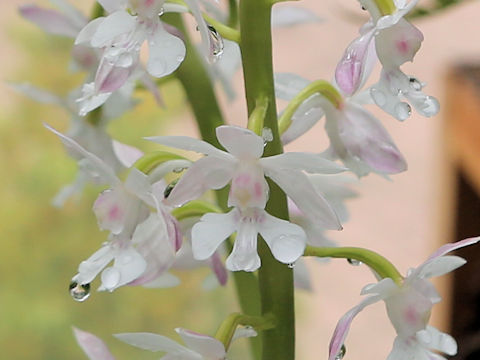
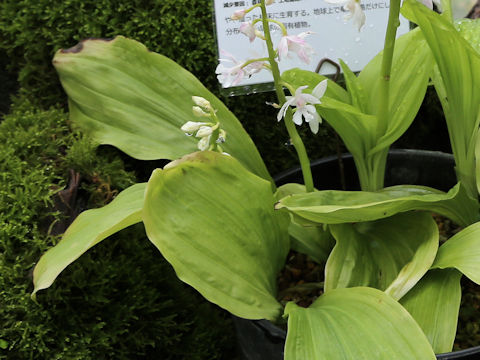
わが国の奄美群島にある奄美大島の固有種です。広葉樹林の林床に生え、高さは30~40センチほどになります。根生葉は1~3個つき倒卵状長楕円形、長さ15~25センチになります。葉は幅が広く、鮮やかな緑色で、硬い質感があります。3月から4月ごろ、花茎を伸ばして総状花序をだし、白色や淡紫色、淡紅色などの花を咲かせます。花の距は7~13ミリと短いのが特徴です。虫媒花ですが、蜜は出さず、虫をだまして花粉媒介に利用していることが、熊本大学の杉浦直人さんの研究で、2022年に判明しました。自生地では、受粉をミツバチ科のオキナワヒゲナガハナバチ(Eucera okinawae)1種に大きく依存しているそうです。環境省のレッドブックでは絶滅危惧IA類(CR)に分類されています。 |
|
|
ラン科エビネ属の常緑多年草で、学名は Calanthe amamiana (syn. Calanthe discolor var. amamiana、Calanthe aristulifera var. amamiana)。英名はありません。 |
|
|
The "Amami-ebine" (Calanthe amamiana) belongs to Orchidaceae (the Orchid family). It is an evergreen herb that is an endemic species found on Amami Oshima in Japan's Amami Islands. It grows on the forest floor of broadleaf forests and reaches a height of about 30 to 40 cm. It has 1 to 3 basal leaves that are obovate-oblong in shape and 15 to 25 cm long. The leaves are broad, bright green, and have a stiff texture. From around March to April, it extends a flower stalk bearing a raceme and produces flowers in shades of white, pale purple, and pale pink. A distinctive feature of this flower is its short spur, which measures 7 to 13 mm. Although it is an insect-pollinated plant, it does not produce nectar; research by Naoto Sugiura of Kumamoto University in 2022 revealed that it deceives insects to utilize them for pollination. In its natural habitat, pollination is said to rely heavily on a single species of bee, the Okinawa long-horned bee (Eucera okinawae). It is classified as Critically Endangered (CR) in the Ministry of the Environment's Red List. |
|
|
茨城県つくば市「つくば実験植物園」にて、2026年03月28日撮影。 |
|
|

|
Shu Suehiro shu@botanic.jp
|
|