
|

|
 えなしひごくさ (柄無し肥後草・籤草)
|
[Index]
[Back]
|
|
|
   |
|

|
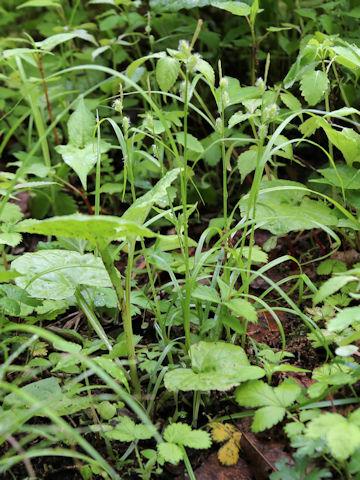
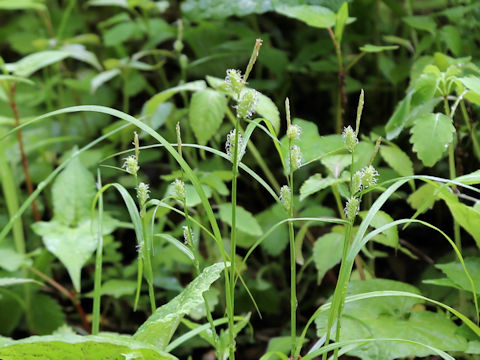
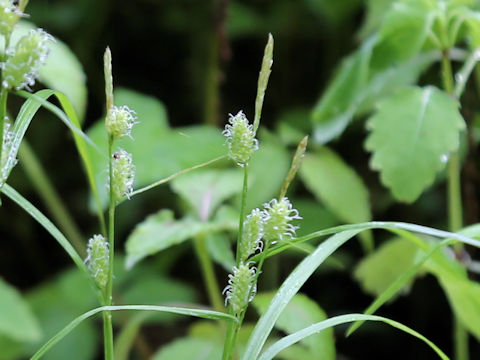
わが国の各地をはじめ、朝鮮半島や中国に分布しています。草地や道ばたに生え、高さは20~40センチになります。細長い根茎を横に伸ばして、まばらに叢生します。葉は鮮緑色で、幅は2~4センチ、長さは花茎より長くなります。基部の鞘は淡褐色をしています。4月から6月ごろ、花茎を伸ばして、小穂を2~4個つけます。頂小穂は雄性で、長さ1.5~3センチの線形、側小穂は雌性で、長さ7~12ミリ、幅6~7ミリの円柱状で、ほとんど柄がありません。和名は、「ひごくさ(肥後草)」に似て、小穂に柄がないことによります。中国語では「匿鱗薹草(ni lin tai cao)」と呼ばれます。 |
|
|
カヤツリグサ科スゲ属の多年草で、学名は Carex aphanolepis (syn. Carex japonica var. aphanolepis)。英名はありません。 |
|
|
The "Enashi-higo-kusa" (Carex aphanolepis) belongs to Cyperaceae (the Sedge family). It is a perennial herb that is distributed throughout Japan, as well as on the Korean Peninsula and in China. It grows in grasslands and along roadsides, reaching a height of 20 to 40 cm. It spreads its slender rhizomes horizontally and grows in sparse clumps. The leaves are bright green, 2-4 cm wide, and longer than the flower stalk. The sheaths at the base are light brown. From around April to June, it produces a flower stalk bearing 2 to 4 spikelets. The terminal spikelet is male, linear in shape and 1.5-3 cm long; the lateral spikelets are female, cylindrical in shape, 7-12 mm long and 6-7 mm wide, and have almost no pedicel. Its Japanese name comes from its resemblance to "Higo-kusa" and the fact that the spikelets lack pedicels. In Chinese, it is called "匿鱗薹草" (ni lin tai cao). |
|
|
熊本県高森町「阿蘇野草園」にて、2026年05月13日撮影。 |
|
|

|
Shu Suehiro shu@botanic.jp
|
|