
|

|
 えぞのきりんそう (蝦夷の麒麟草) |
[Index]
[Back]
|
|
|
  |
|

|
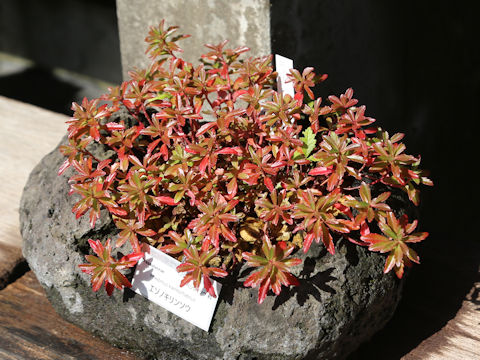
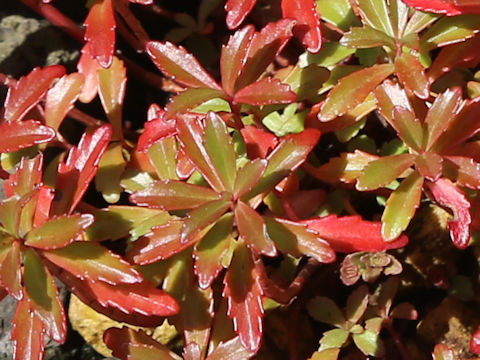
わが国の本州、青森県の下北半島から北海道、それに朝鮮半島中部・北部から中国東北部、ロシア極東部、千島列島、カムチャッカ半島に分布しています。低山帯から高山帯の岩場に生え、高さは10~20センチになります。茎は太い根茎から叢生して、地面を匍匐します。葉は扁平で多肉質、上半部に鋸歯があります。7月から8月ごろ、茎の先に多数の黄色い花を咲かせます。雄しべの葯は、はじめ紅紫色、のち黄色になります。中国語では「堪察加費菜(kan cha jia fei cai)」と呼ばれます。 韓国語では「エギギリンチョ(애기기린초)」です。これは「赤ちゃん(エギ: 애기)」+「キリンソウ(キリンチョ: 기린초)」の合成語です。 |
|
|
ベンケイソウ科マンネングサ属の常緑多年草で、学名は Sedum kamtschaticum (syn. Phedimus kamtschaticus)。英名は Kamchatka stonecrop。 |
|
|
The Kamchatka stonecrop (Sedum kamtschaticum) belongs to Crassulaceae (the Orpine family). It is an evergreen herb that is distributed from the Shimokita Peninsula in Aomori Prefecture of Honshu to Hokkaido in Japan, as well as across the central and northern parts of the Korean Peninsula, northeastern China, the Russian Far East, the Kuril Islands, and the Kamchatka Peninsula. It grows on rocky slopes in low to high altitude mountain zones and reaches a height of 10 to 20 cm. Stems grow in clumps from thick rhizomes and creep along the ground. The leaves are flat and fleshy, with serrated edges on the upper half. From around July to August, numerous yellow flowers bloom at the tips of the stems. The anthers of the stamens are initially reddish-purple and later turn yellow. In Chinese, it is called "堪察加費菜" (kan-cha-jia-fei-cai)". In Korean, it's called "ae-gi-gi-rin-cho" (애기기린초). This is a compound word consisting of "baby" (ae-gi: 애기) + "kirin-so" (ki-rin-cho: 기린초). |
|
|
北海道札幌市中央区「北海道大学植物園」にて、2026年09月30日撮影。 |
|
|

|
Shu Suehiro shu@botanic.jp |
|