

|
 えぞのちちこぐさ (蝦夷の父子草) |
|
|
       |
|

|
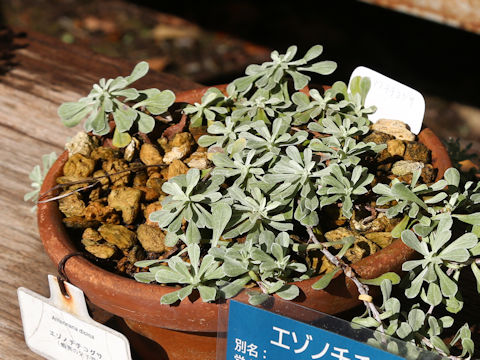
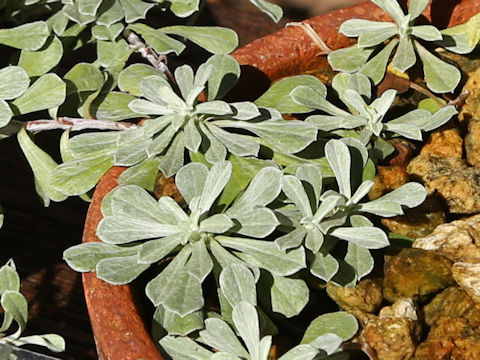
わが国の北海道、礼文島と大雪・阿寒・知床山系、それに朝鮮半島北部、中国北部、ユーラシア北部およびアラスカに分布しています。高山帯に生え、高さは5~20センチになります。葉はやや小さな披針形で、灰緑色をしています。全体に白い細毛で被われます。6月から8月ごろ、茎の先に散房花序をつけ、白色またはピンク色の頭花を咲かせます。中国語では「蝶鬚(die xu)」と呼ばれます。 韓国語では「ペクトゥサンットクスク(백두산떡쑥)」です。これは「白頭山(ペクトゥサン: 백두산)」+「ハハコグサ(ットクスク: 떡쑥)」の合成語です。白頭山などの高山地帯に生えることからこの名が付けられています。 |
|
|
キク科エゾノチチコグサ属の常緑多年草で、学名は Antennaria dioica。英名は Catsfoot。 |
|
|
The Catsfoot (Antennaria dioica) belongs to Asteraceae (the Aster family). It is an evergreen perennial herb that is found in Japan's Hokkaido-specifically on Rebun Island and in the Daisetsuzan, Akan, and Shiretoko mountain ranges-as well as in the northern part of the Korean Peninsula, northern China, northern Eurasia, and Alaska. This herb grows in alpine zone and it can reach 5-20 cm in height. The leaves are small lanceolate and grayish green. The all parts of plant are covered with white fine hairs. The corymbs are borne on the stem apices, and the white or pink flower-heads bloom from June to August. It is called "蝶鬚" (die xu) in Chinese. In Korean, it's called "baek-du-san-tteok-ssuk" (백두산떡쑥). This is a compound word consisting of "Mount Paektu" (baek-du-san: 백두산) + "Hahako-gusa" (tteok-ssuk: 떡쑥). It was given this name because it grows in high-altitude regions such as Mount Paektu. |
|
|
[上・中1] スイス・ベルン州「シーニゲプラッテ高山植物園」にて、2009年06月30日撮影。(photo by Jon Suehiro) [中2] 長野県山ノ内町「東舘山高山植物園」にて、2003年06月15日撮影。 [中3・中4] イギリス・スコットランド・アビモアにて、2016年06月04日撮影。(photo by Jon Suehiro) [中5・下] 北海道札幌市中央区「北海道大学植物園」にて、2026年09月30日撮影。 |
|
|

|
Shu Suehiro shu@botanic.jp |