 |


|

|
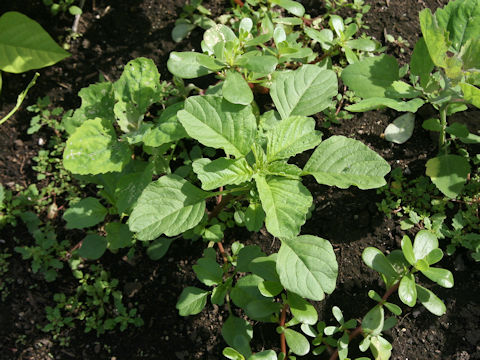
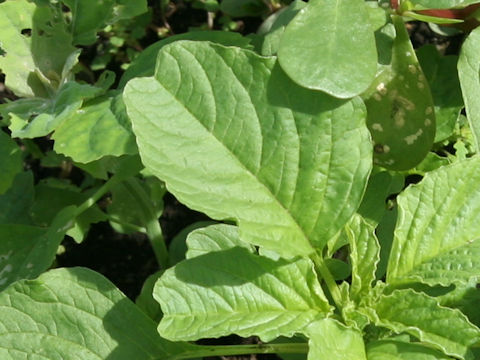
熱帯アメリカが原産です。わが国へは、江戸時代の末期に渡来しました。いまではわが国の各地に分布し、畑や道端にふつうに見られます。茎は根元で分枝して斜めに立ち上がり、高さは30~60センチになります。茎は薄い茶褐色をしています。葉は菱状卵形で長い柄があり、先端がくぼみます。6月から10月ごろ、茎の先に穂状花序をだし、多数の花を密につけます。C4植物(C4型光合成を行う植物)です。台湾華語では「凹葉野莧菜」、中国語では「凹頭莧(ao tou xian)」と呼ばれます。
韓国語では「ケビルム(개비름)」です。これは「犬(ケ: 개)」+「ヒユナ(ピルム: 비름)」の合成語です。「ケ(개)」は、何か異なっていたり、少し劣っていることを表す接頭辞です。
|
|
|
ヒユ科ヒユ属の一年草で、学名は Amaranthus lividus var. ascendens (syn. Amaranthus blitum ssp. blitum)。英名は Livid amaranth、Slender amaranth。
|
|
|
The Livid amaranth (Amaranthus lividus var. ascendens) belongs to Amaranthaceae (the Amaranth family). It is an annual herb that is native to tropical America. It was introduced into Japan at the end of the Edo period (1603-1867). This herb grows now all over Japan and is commonly found in fields and roadsides. The stem branches at the root and rises diagonally, reaching a height of 30-60 cm. The stem is light brown. The leaves are rhombic-ovate, with long stalks and dented tips. The spikes are borne on the tips of the stems and many flowers are densely attached from June to October. It is a C4 plant (Plants with C4-type photosynthesis). In taiwanese Chinese, it is called "凹葉野莧菜", and "凹頭莧" (ao tou xian) in Chinese.
In Korean, it's called "kae-bi-reum" (개비름). This is a compound word consisting of "dog" (kae: 개) + "Chinese spinach" (bi-reum: 비름). "kae" is a prefix that indicates something is different or slightly inferior. In commercial contexts,
|
|
|
[上・中1] 大阪府四條畷市清滝中町にて、2002年09月22日撮影。
[中2~中5] 宮城県川崎町支倉にて、2020年07月13日撮影。
[中6~中10] 同上にて、2021年08月22日撮影。
[中11・下] 同上にて、2025年07月18日撮影。
|

 いぬびゆ (犬びゆ)

 shu@botanic.jp