

|
 いぬこりやなぎ (犬行李柳) |
|
|
|
-- もっと見る(Show more)--
-- 閉じる(Close) --
|
|
|
|

|
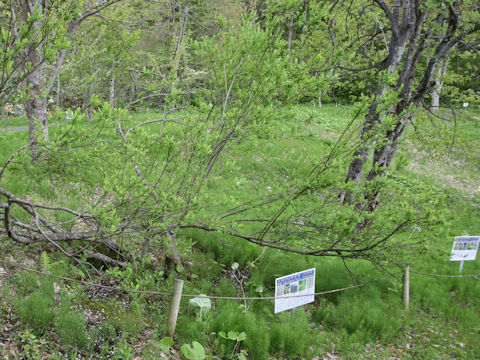
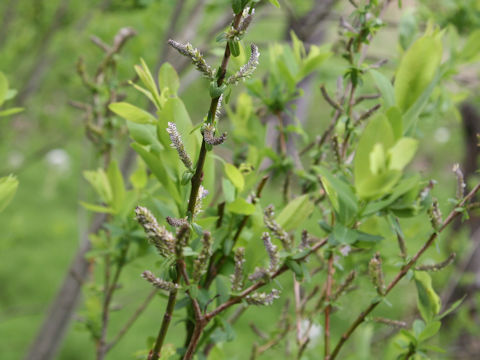
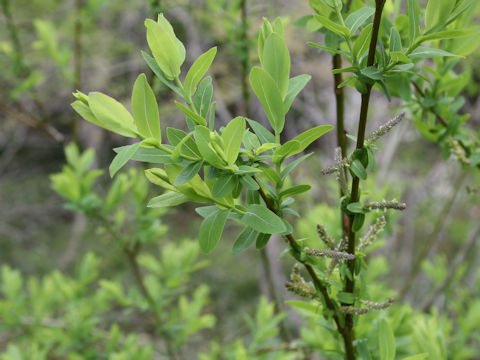
わが国の各地をはじめ、南千島や朝鮮半島、中国北部、極東ロシアにも分布しています。日当たりの良い湿地や川岸などに生え、高さは2~3メートルほどになります。葉は楕円形で長さは5センチほど、先端が尖らず対生します。雌雄異株で、3月から5月ごろ、葉に先立って短い花穂をつけます。また種子は白い綿毛に包まれます。和名は、柳行李の材料として栽培される「こりやなぎ(Salix koriyanagi)」に似て、質が劣ることから。中国語では「杞柳(qi liu)」と呼ばれます。 韓国語では「ケキボドゥル(개키버들)」です。これは「犬(ケ: 개)」+「コリヤナギ(キボドゥル: 키버들)」の合成語です。「ケ(개)」は、何か異なっていたり、少し劣っていることを表す接頭辞です。「キボドゥル(키버들)」は、朝鮮半島特産の「コリヤナギ(Salix koriyanagi)」の意味です。 |
|
|
ヤナギ科ヤナギ属の落葉低木で、学名は Salix integra。英名はありません。 |
|
|
The "Inu-kori-yanagi" (Salix integra) belongs to Salicaceae (the Willow family). It is a small deciduous tree that is found throughout Japan, as well as in the Southern Kuril Islands, the Korean Peninsula, northern China, and the Russian Far East. This tree grows in sunny marshes or stream banks and it can reach 2-3 m in height. The leaves are elliptic, about 5 cm long and opposite with dull points. It is dioecious. The short catkins are borne from March to May before foliation. The seeds are covered with woolly hairs. Its Japanese name comes from its resemblance to "Korean willow" (Salix koriyanagi)-a willow species cultivated for use in making willow trunks-but it is of inferior quality. It is called "杞柳" (qi liu) in Chinese. In Korean, it's called "gae-ki-beo-deul" (개키버들). This is a compound word consisting of "dog" (gae: 키버들) + "Korean basket willow" (ki-beo-deul: 키버들). "gae" (개) is a prefix used to indicate that something is different or slightly inferior. "ki-beo-deul" (키버들) refers to the "Korean basket willow" (Salix koriyanagi), a species native to the Korean Peninsula. |
|
|
[上・中1] 群馬県利根町「赤城山」にて、2008年04月26日撮影。 [中2] 群馬県富士見町「赤城ふれあいの森」にて、2008年04月27日撮影。 [中3・中4] 長野県松本市「内田少年の森」にて、2005年05月21日撮影。 [中5・中6] 茨城県つくば市「つくば実験植物園」にて、2013年01月19日撮影。 [中7~中13] 宮城県白石市小原にて、2017年04月10日撮影。 [中14~中17] 山形県小国町小玉川にて、2018年04月14日撮影。 [中18・中19] 同上にて、2018年04月19日撮影。 [中20~中28] 同上にて、2018年04月24日撮影。 [中35・中36] 同上にて、2019年03月01日撮影。 [中37~中41] 同上にて、2019年03月20日撮影。 [中29~中31] 長野県小海町豊里にて、2018年05月18日撮影。 [中32~中34] 青森市三内「三内丸山遺跡」にて、2018年07月15日撮影。 [中42~43・下] 山形市神尾「山形市野草園」にて、2025年05月11日撮影。 |


|
|

|
Shu Suehiro shu@botanic.jp |