
|

|
 いしかぐま (石かぐま) |
[Index]
[Back]
|
|
|
     |
|

|
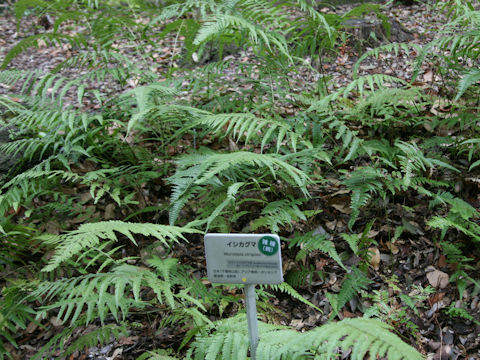
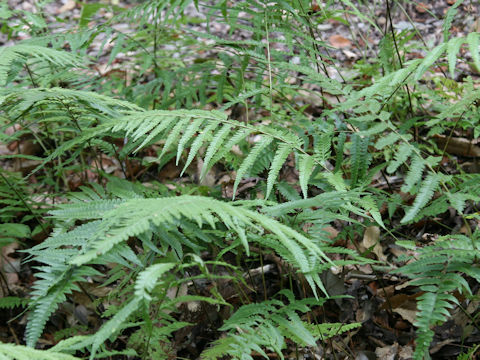
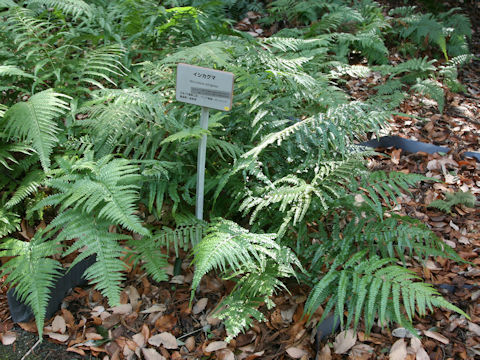
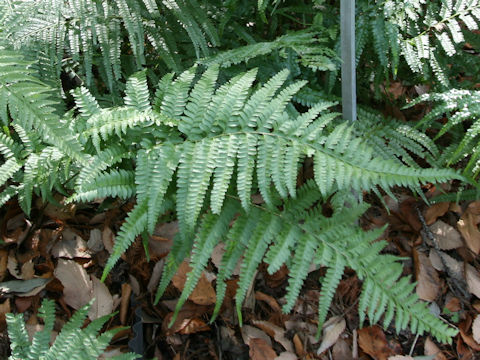
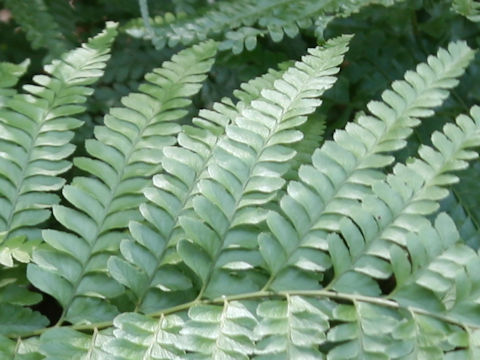
わが国の本州、房総半島南部以西から海岸沿い、四国・九州、それに台湾や中国南部、ヒマラヤ周辺からインド、マレー半島からポリネシアに広く分布しています。人家の周辺から林縁、谷筋、山地などに生え、高さは50~80センチになります。葉は2回羽状複葉で黄緑色から暗緑色、やや光沢があり、やや硬い草質です。側羽片の数は20対以上あります。ソーラスは羽片の辺縁近くにつき、包膜はコップ状です。「かぐま」とは「しだ」の古名のひとつで、本種の和名は「石のごろごろしている所に生える羊歯」という意味。台湾華語では「粗毛鱗蓋蕨」、中国語では「粗毛鱗蓋蕨(cu mao lin gai jue)」と呼ばれます。 韓国語では「トルトッキゴサリ(돌토끼고사리)」です。これは「石(トル: 돌)」+「ウサギシダ(トッキゴサリ: 토끼고사리)」の合成語です。「岩の隙間で育つウサギシダ」という意味に由来しています。 |
|
|
コバノイシカグマ科フモトシダ属の常緑シダ類で、学名は Microlepia strigosa。英名はありません。 |
|
|
The "Ishi-kaguma" (Microlepia strigosa) belongs to Dennstaediaceae (the Bracken family). It is an evergreen fern that is distributed along the coast from the southern Boso Peninsula of Honshu westward to Shikoku and Kyushu in Japan, as well as Taiwan, southern China, the Himalayan region, India, the Malay Peninsula, and Polynesia. It grows around houses, at forest edges, along valleys, and in mountains, and is 50 to 80 cm tall. The leaves are bipinnate compound, yellowish green to dark green, slightly shiny, and somewhat hardy. There are more than 20 pairs of lateral pinnae. The sorus is attached near the margins of the pinnae and the indisum is cup-shaped. "Kaguma" is one of the ancient names for "fern" in Japan, and the Japanese name for this species means "fern that grows on stony ground". In Taiwanese Chinese, it is called "粗毛鱗蓋蕨" and in Chinese "粗毛鱗蓋蕨" (cu mao lin gai jue). In Korean, it's called "dol-tokk-i-go-sa-ri" (돌토끼고사리). This is a compound word consisting of "stone" (dol: 돌) + "Western oak fern" (tokk-i-go-sa-ri: 토끼고사리). The name comes from the fact that it is a "Western oak fern that grows in crevices in rocks". |
|
|
茨城県つくば市「つくば実験植物園」にて、2025年01月25日撮影。 |
|
|

|
Shu Suehiro shu@botanic.jp |
|