 |
|

|
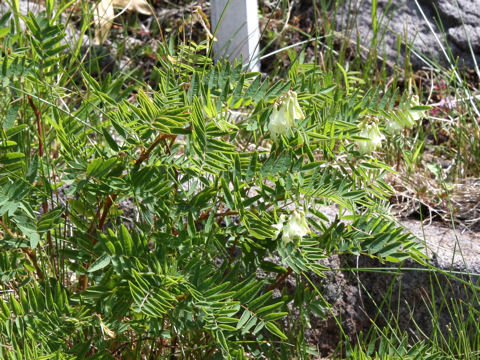
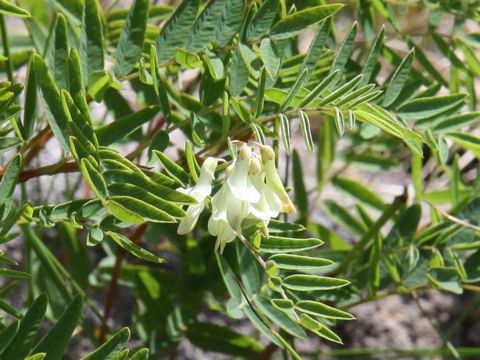
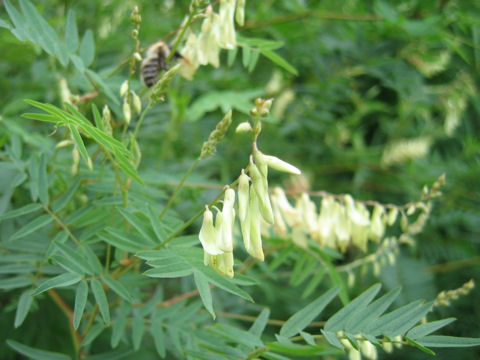
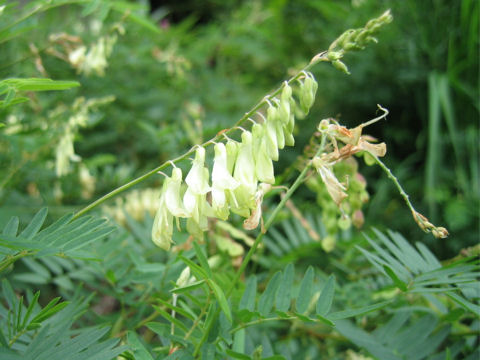
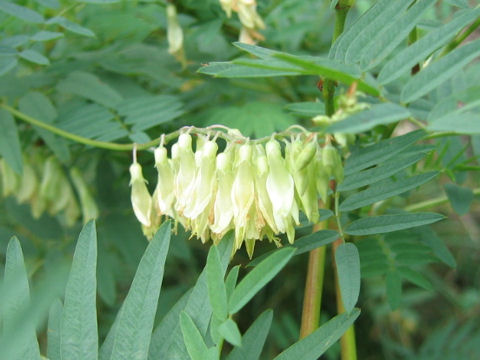
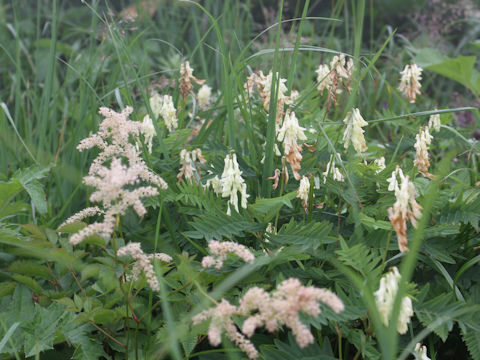
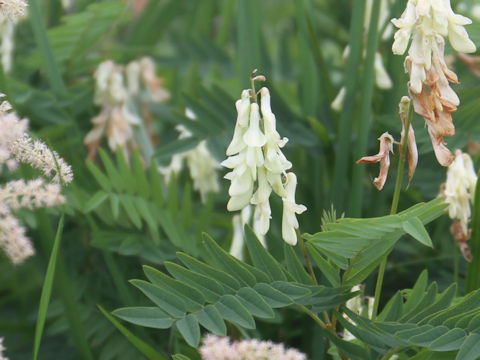
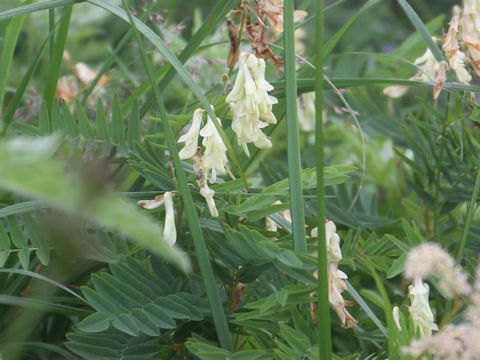
わが国の本州、中部地方以北から北海道、それに朝鮮半島北部や中国東北部、東シベリアに分布しています。亜高山帯から高山帯の砂礫地や草地に生え、高さは30~80センチになります。葉は奇数羽状複葉で、小葉は5~12対あり狭い卵形をしています。7月から8月ごろ、花茎を伸ばして淡い黄白色の花を下垂して咲かせます。和名は、漢方で強壮薬として使用される黄耆(おうぎ)に似て、岩場に生えることから。中国語では「太白岩黄耆(tai bai yan huang qi)」と呼ばれます。
韓国語では「ナドファンギ(나도황기)」です。これは「私も(ナド: 나도)」+「黄耆(ファンギ: 황기)」の合成語です。接頭辞「ナド」は、他の植物に似ているけれど、その植物ではない場合に付けられます。
|
|
|
マメ科イワオウギ属の多年草で、学名は Hedysarum vicioides (syn. Hedysarum vicioides ssp. japonicum var. japonicum)。英名はありません。
|
|
|
The "Iwa-ougi" (Hedysarum vicioides) belongs to Fabaceae (the Pea family). It is a perennial herb that is distributed northward from Chubu district of Honshu to Hokkaido, as well as the northern Korean Peninsula, northeastern China and East Siberia. This herb grows in sub-alpine to alpine screes or grasslands, and can reach 30-80 cm in height. The leaves are impari-pinnate compound with 5-12 pairs of narrow ovate leaflets. The flowering stalks are borne and the pale yellowish white flowers bloom facing downward from July to August. The Japanese name comes from its resemblance to "ougi" (Astragalus membranaceus), a herb used in traditional Chinese medicine as a tonic, and the fact that it grows on rocky ground. It is called "太白岩黄耆" (tai bai yan huang qi) in Chinese.
In Korean, it's called "na-do-hwang-gi" (나도황기). This is a compound word consisting of "nado-" (me too: 나도) + "Mongolian milkvetch" (hwang-gi: 황기). The prefix "nado-" is used when a plant resembles another plant but is not that plant.
|
|
|
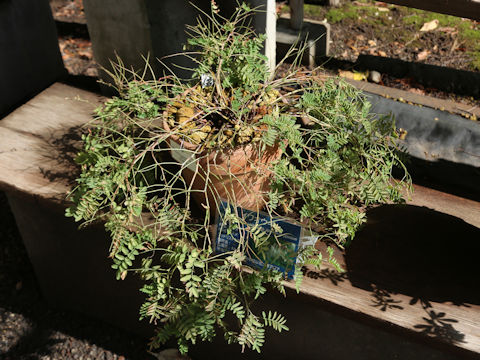
[上・中1] 長野県山ノ内町「東館山高原植物園」にて、2010年07月25日撮影。
[中2~中4] 岐阜県白川村飯島「三方岩岳」にて、2004年08月08日撮影。
[中5~中7] 長野県白馬村「唐松岳」にて、2016年07月30日撮影。
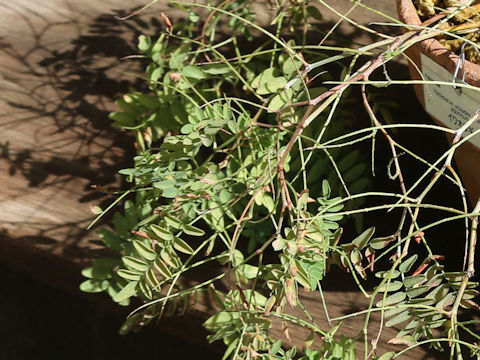
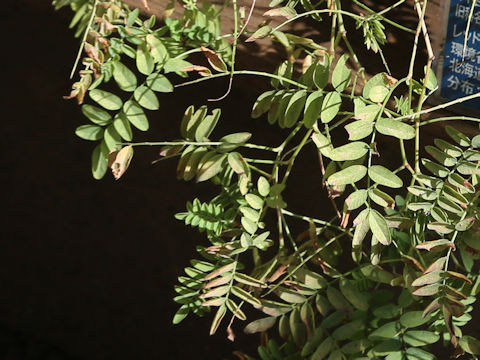
[中8~9・下] 北海道札幌市中央区「北海道大学植物園」にて、2026年09月30日撮影。
|

 いわおうぎ (岩黄耆)

 shu@botanic.jp