
|

|
 おぎ (荻) |
[Index]
[Back]
|
|
|
|
-- もっと見る(Show more)--
-- 閉じる(Close) --
|
|
|
|

|
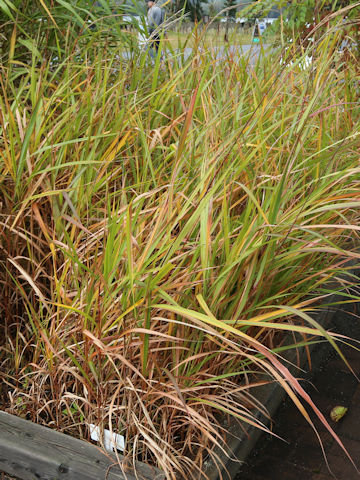
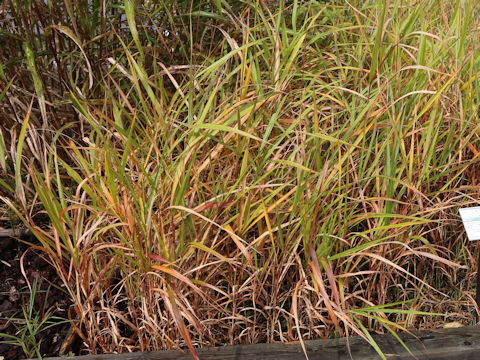
わが国の各地をはじめ、朝鮮半島や中国に分布しています。水辺の湿地に生えて、高さは1~2.5メートルになります。根茎は横に広がり、しばしば大きな群落を形成します。稈が地面から1本ずつ独立して生えているのが特徴です。葉は長い線形で、長さは50~80センチになり、叢生します。9月から10月ごろ、長さ25~40センチの大きな花穂をつけます。穂の先端に芒がなく、長い毛がふわっとしています。かつては、屋根葺き材料として広く用いられていました。写真中17・18および中26~中38は、小玉川の萱場です。中国語では「荻(di)」と呼ばれます。C4植物(C4型光合成を行う植物)です。 韓国語では「ムロクセ(물억새)」です。これは「水(ムル: 물)」+「ススキ(オクセ: 억새)」の合成語です。「水辺に生えるススキ」という意味に由来しています。 |
|
|
イネ科ススキ属の多年草で、学名は Miscanthus sacchariflorus。英名は Amur silver-grass。 |
|
|
The Amur silver-grass (Miscanthus sacchariflorus) belongs to Poaceae (the Grass family). It is a perennial herb that is native to throughout Japan, as well as the Korean Peninsula and China. This grass grows in the bogs of water's edges and can reach 1-2.5 m in height. The rhizomatous roots extend transversally and the grass grows often in large clumps. A distinctive feature is that the stalks grow individually, one by one, from the ground. The leaves are long linear, 50-80 cm long, and clumping. The large spikes, 25-40 cm long, are borne from September to October. The tips of the spikes have no awns, and the long hairs are soft and fluffy. It was widely used as a roofing materials at one time. The 18th-19th and 27th-39th photos show the Kayaba (A place to cut the thatch used for roofing) of Oaza Kodamagawa in Oguni Town, Yamagata Prefecture. In Chinese, it is called "荻" (di). It is a C4 plant (Plants with C4-type photosynthesis). In Korean, it's called "mul-eok-sae" (물억새). This is a compound word consisting of "water" (mul: 물) + "Eulalia" (eok-sae: 억새). The name comes from the phrase "pampas grass growing by the water's edge". |
|
|
[上・中1~11] 千葉県香取市久保「黒部川」にて、2013年10月10日撮影。 [中12~中14] 埼玉県さいたま市「田島ヶ原」にて、2010年04月11日撮影。 [中15・中16] 茨城県桜川市真壁町にて、2013年11月23日撮影。 [中17・中18] 山形県小国町小玉川にて、2011年11月06日撮影。 [中26~中29] 同上にて、2017年11月03日撮影。 [中30・中31] 同上にて、2018年05月23日撮影。 [中32~中34] 同上にて、2018年11月03日撮影。 [中35~中38] 同上にて、2018年10月16日撮影。 [中19~中23] 山形県小国町泉岡にて、2017年10月05日撮影。 [中24・中25] 佐賀県吉野ヶ里町「吉野ヶ里歴史公園」にて、2017年10月07日撮影。 [中39~中41] 山形県南陽市梨郷にて、2019年09月28日撮影。 [中42・下] 北海道白老町若草町「ウポポイ」にて、2026年10月01日撮影。 |


|
|

|
Shu Suehiro shu@botanic.jp |
|