
|

|
 おもろかんあおい (おもろ寒葵)
|
[Index]
[Back]
|
|
|
      |
|

|
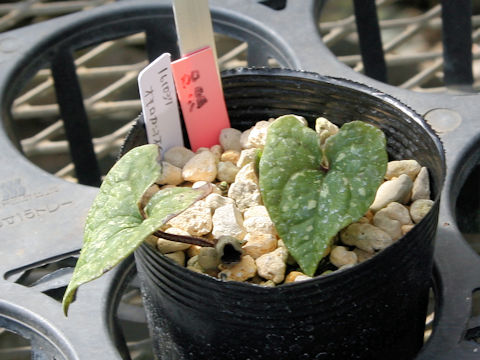
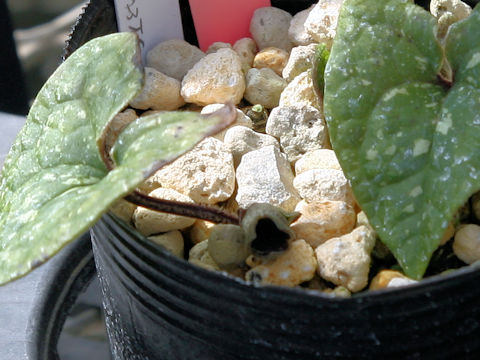
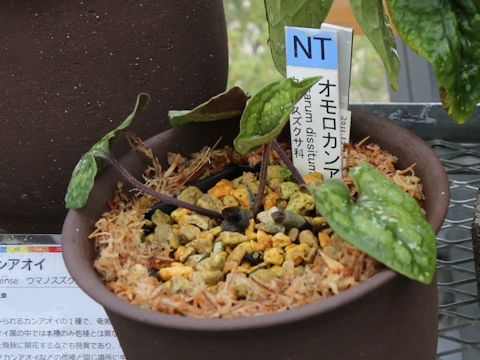
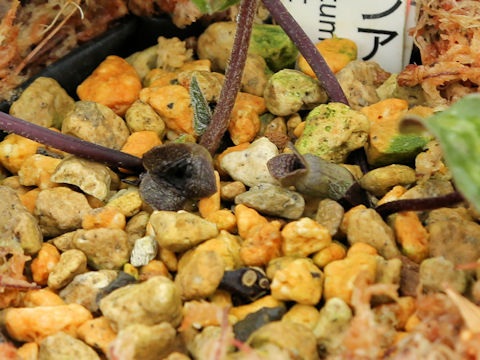
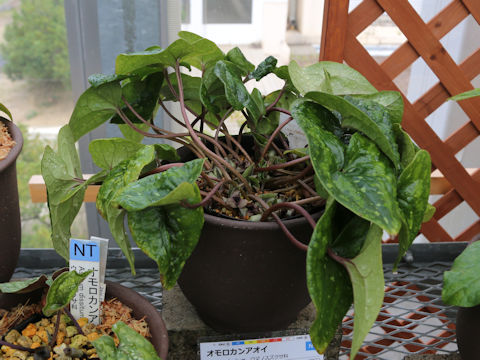
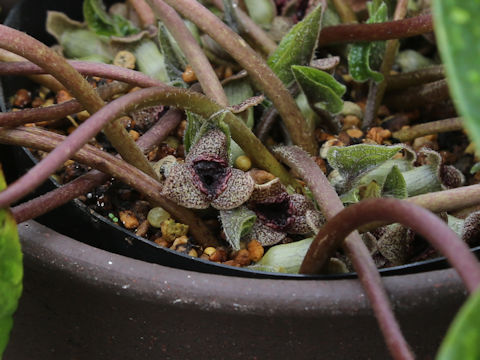
わが国の南西諸島、石垣島と西表島の固有種です。山地の常緑広葉樹林内の林床に生え、高さは10~15センチほどになります。葉は卵心形で緑色、緑白斑が入ります。葉には細毛が散生し、葉脈に沿ってくぼみます。1月から3月ごろ、淡褐色から黄緑色で紫色の斑点がある花を咲かせます。萼筒は楕円形から円柱形で、先端から1/3のところで軽く括れます。また萼裂片は3個あり開出します。雄しべは6個、雌しべの花柱は3個あります。環境省レッドデータでは準絶滅危惧(NT)に指定されています。和名は、琉球の古い歌集「おもろさうし(おもろ草紙)」に由来します。 |
|
|
ウマノスズクサ科カンアオイ属の常緑多年草で、学名は Asarum dissitum (syn. Heterotropa dissita)。英名はありません。 |
|
|
The "Omoro-kan-aoi" (Asarum dissitum) belongs to Aristolochiaceae (the Birthwort family). It is a perennial herb that is endemic to the Ryukyu Islands, specifically Ishigaki Island and Iriomote Island. It grows on the forest floor within evergreen broadleaf forests in mountainous areas, reaching a height of about 10 to 15 cm. The leaves are ovate-cordate, green in color, and feature greenish-white spots. Fine hairs are scattered on the leaves, which are concave along the veins. From January to March, it blooms with pale brown to yellow-green flowers bearing purple spots. The calyx tube is elliptical to cylindrical, slightly constricted one-third from the tip. It has three spreading calyx lobes. There are 6 stamens and 3 pistils. It is designated as Near Threatened (NT) in the Environment Ministry's Red Data Book. Its Japanese name originates from the ancient Ryukyu song collection "Omoro-soshi" (Omoro bound text). |
|
|
[上・中1] 茨城県つくば市「つくば実験植物園」にて、2026年03月07日撮影。 [中2~4・下] 同上にて、2026年03月28日撮影。 |
|
|

|
Shu Suehiro shu@botanic.jp
|
|