
|
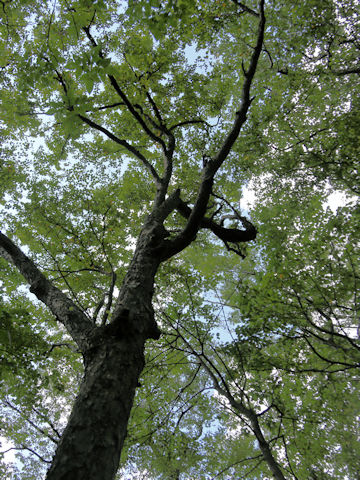
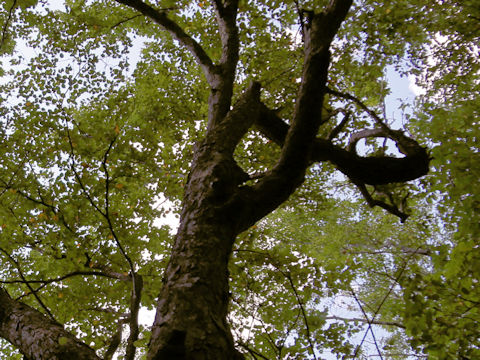
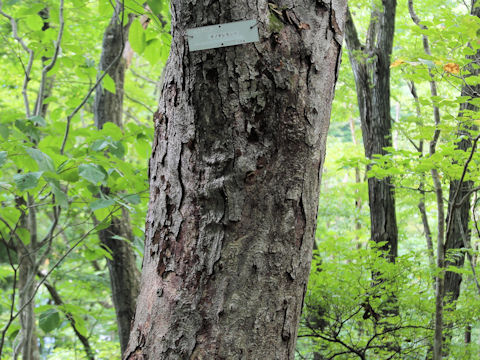
The "Ono-ore-kanba" (Betula schmidtii) belongs to Betulaceae (the Birch family). It is a tall decidous tree that is distributed primarily along the Pacific coast of Japan's Honshu Island, from the Chubu region northward, as well as on the Korean Peninsula, in northeastern China, and in the Ussuri region. It grows in rocky areas and along ridges, reaching a height of about 15 m. The bark is blackish-brown to grayish-brown and cracks into a tortoiseshell pattern as the tree ages. The leaves are long-ovate with sharply pointed tips and irregular, fine serrations along the margins. The leaves turn yellow in the fall. Flowering occurs around May, coinciding with the unfolding of the leaves. Male inflorescences hang downward from the tips of branches, while female inflorescences stand upright at the tips of short branches. The fruit is a nut; the catkins are cylindrical, 2 to 4 cm long, and point upward, ripening from September to October. The Japanese name derives from the fact that the wood is so hard it can even break an axe. In Chinese, it is called "賽黑樺" (sai hei hua). In Korean, it is known as "Bak-dal-namu: 박달나갬".
|


 おのおれかんば (斧折れ樺)

 shu@botanic.jp