
|
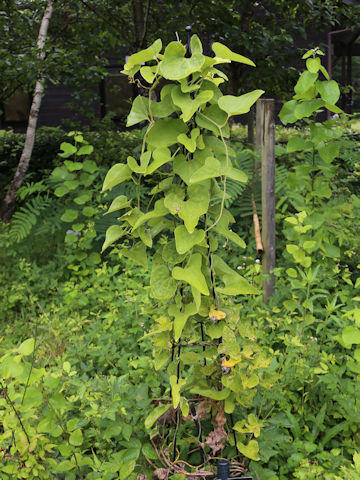
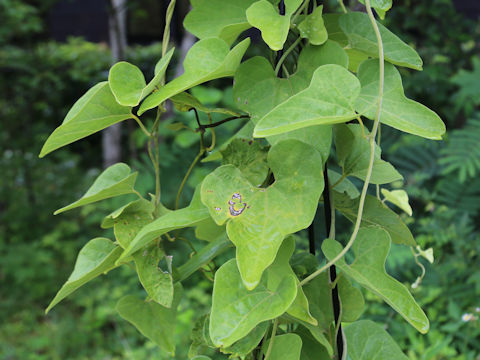
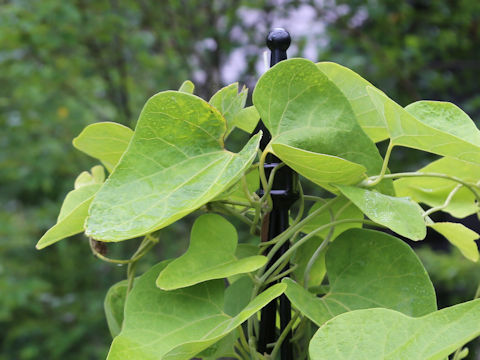
The "Ooba-umano-suzukusa" (Aristolochia kaempferi) belongs to Aristolochiaceae (the Birthwort family). It is a climbing deciduous shrub that is distributed across Japan's Honshu Island, from the Pacific coast of the Kanto region to the Chugoku region, as well as in Shikoku and Kyushu. It grows in the forests of low mountains; its vines become woody and entwine with other plants, reaching a height of 2 to 3 m. The leaves are rounded-cordate, broadly ovate, or triangular-cordate, with a cordate base. Some leaves are often three-lobed, with the lateral lobes forming round, ear-like structures and the central lobe becoming elongated. From around May to June, it produces one flower-rarely two-in each leaf axil. It has no petals; instead, three sepals are fused to form a calyx tube. The calyx tube is usually yellowish-green, with reddish-brown to deep purple stripes, and often has a net-like pattern over its entire surface or lower portion. Rarely, the entire calyx tube may be dark purple or cream-colored. The inner surface of the calyx tube is yellowish-green; some specimens have dense purplish-brown spots, while others are uniformly purplish-brown without spots. The f
|


 おおばうまのすずくさ (大葉馬の鈴草)

 shu@botanic.jp