
|
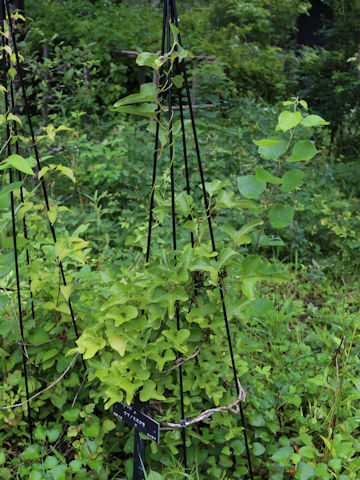
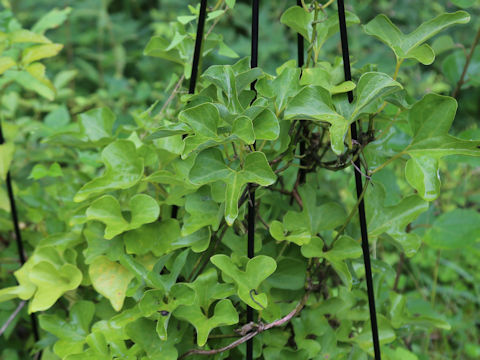
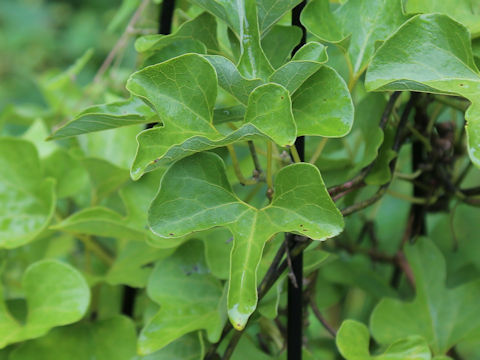
The Slender Dutchman's pipe (Aristolochia debilis) belongs to Aristolochiaceae (the Birthwort family). It is a perennial herb that is distributed throughout Japan, from Honshu to Shikoku and Kyushu, as well as from the central-eastern to central-southern regions of China. It grows in mixed forests in mountainous areas and in humid valleys; it is a vine that grows to 2-3 m in length and twines around other plants. The entire plant is hairless, has a whitish-powdery appearance, and emits a distinctive odor. The leaves are thick and papery, triangular-ovate in shape, with a heart-shaped base and ear-like projections on both sides. From around June to September, it produces one flower-rarely two-in each leaf axil. It has no petals; the three sepals are fused to form a calyx tube. The calyx tube is yellowish-green, with a purplish-brown interior. The fruit is a spherical to elliptical capsule; it is said to bear fruit only rarely in Japan. This species is the food plant for the caterpillars of the "Chinese windmill". As the caterpillars feed on the leaves, they accumulate the plant's toxins in their bodies, which they use to protect themselves from natural enemies such as birds. It is called "馬兜鈴" (ma dou ling) in Chinese.
|


 うまのすずくさ (馬の鈴草)

 shu@botanic.jp