
|

|
 ぼだいじゅ (菩提樹)
|
[Index]
[Back]
|
|
|
   |
|

|
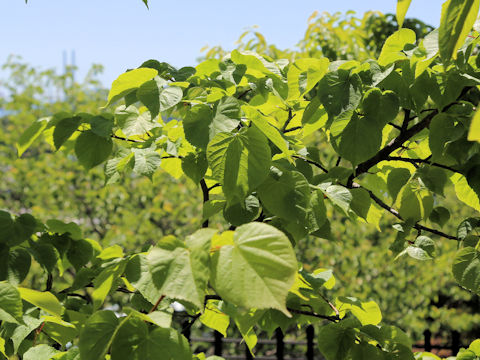
中国の南西部、安徽省から広東省、江蘇省、江西省、浙江省に分布しています。わが国へは、12世紀半ばに臨済宗の開祖である栄西が中国から持ち帰ったと伝えられます。わが国では各地の仏教寺院によく植えられています。高さは30メートルほどになり、樹皮は紫色がかった灰色で、樹齢を重ねると縦に浅く裂けます。葉は三角状心形で、長さ5~10センチ、縁には細かい鋸歯があります。葉の左右の形が微妙に異なり、非対称になるのが特徴です。5月から6月ごろ、葉腋から下垂する集散花序を出し、芳香がある淡黄色の花を咲かせます。果実は球形の堅果で、黄褐色に熟します。この果実は、念珠を作るのに使われます。別名では「こばのしなのき(小葉の科の木)」。中国語では「南京椴(nan jing duan)」と呼ばれます。 |
|
|
シナノキ科シナノキ属の落葉高木で、学名は Tilia miqueliana (syn. Tilia franchetiana)。英名は Miquel's lime。 |
|
|
The Miquel's lime (Tilia miqueliana) belongs to Tiliaceae (the Linden family). It is a tall deciduous tree that is native to southwestern China, ranging from Anhui Province to Guangdong, Jiangsu, Jiangxi, and Zhejiang provinces. It is said to have been brought to Japan from China in the mid-12th century by Eisai, the founder of the Rinzai school of Zen Buddhism. In Japan, it is commonly planted at Buddhist temples throughout the country. The tree grows to a height of about 30 m. Its bark is a purplish gray and develops shallow vertical fissures as it ages. The leaves are triangular-cordate, 5 to 10 cm long, with fine serrations along the edges. A distinctive feature is that the left and right leaves differ slightly in shape, resulting in asymmetry. From around May to June, it produces pendulous corymbs from the leaf axils, blooming with fragrant, pale yellow flowers. The fruit is a spherical nut that ripens to a yellowish-brown color. These fruits are used to make rosaries. It is also known as "Kobano-shinano-ki". In Chinese, it is called "南京椴" (nan jing duan). |
|
|
長崎市南山手町「グラバー園」にて、2026年05月11日撮影。 |
|
|

|
Shu Suehiro shu@botanic.jp
|
|