
|

|
 はまじんちょう (浜沈丁)
|
[Index]
[Back]
|
|
|
  |
|

|
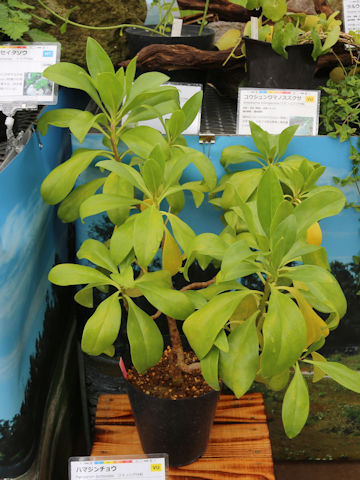
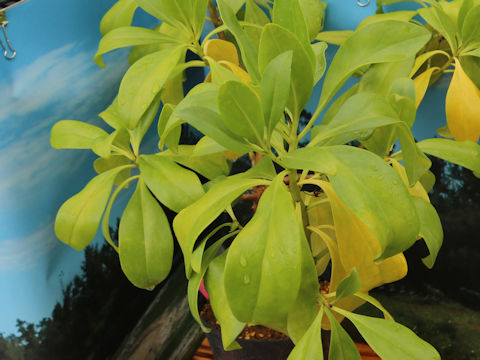
わが国の本州、三重県以西から九州西南部、南西諸島、それに台湾や中国南部、インドシナ半島に分布しています。沿海部の塩沼やマングローブ付近の岩地・砂浜に生え、高さは1~2メートルになります。枝はよく分枝します。葉は長楕円形から楕円形で肉厚、縁は全縁で互生します。1月から3月ごろ、葉腋に直径2~3センチほどで薄紫色の花を咲かせます。花弁は漏斗状で先端が5裂します。果実は先が尖った球形の核果です。またその果皮はコルク質で海水に浮く性質を持ち、海流に乗って運ばれることで分布を広げる「海流散布」を行う植物です。環境省のレッドリストでは絶滅危惧II類(VU)に指定されています。台湾華語では「苦藍盤」、中国語では「苦檻藍(ku jian lan)」と呼ばれます。 |
|
|
ハマジンチョウ科ハマジンチョウ属の常緑小低木で、学名は Myoporum bontioides (syn. Pentacoelium bontioides)。英名はありません。 |
|
|
The "Hama-jincho" (Myoporum bontioides) belongs to the family Myoporaceae. It is an evergreen shrub that is distributed from Mie Prefecture and westward on Honshu, through southwestern Kyushu and the Nansei Islands, as well as in Taiwan, southern China, and the Indochina Peninsula. It grows on rocky areas and sandy beaches near coastal salt marshes and mangroves, reaching a height of 1 to 2 m. The branches are highly branched. The leaves are oblong to elliptical, thick, with entire margins, and arranged alternately. From January to March, it produces pale purple flowers about 2-3 cm in diameter in the leaf axils. The petals are funnel-shaped and five-lobed at the tip. The fruit is a spherical drupe with a pointed tip. The fruit's skin is cork-like and floats on seawater, allowing the plant to spread its distribution through "ocean current dispersal" as it is carried by ocean currents. It is listed as Vulnerable (VU) on the Ministry of the Environment's Red List.It is called "苦藍盤" in Taiwanese Chinese and "苦檻藍" (ku jian lan) in Chinese. |
|
|
茨城県つくば市「つくば実験植物園」にて、2026年03月28日撮影。 |
|
|

|
Shu Suehiro shu@botanic.jp
|
|