
|

|
 ヘレボルス・ムルチフィドゥス・イストリアクス
|
[Index]
[Back]
|
|
|
  |
|

|
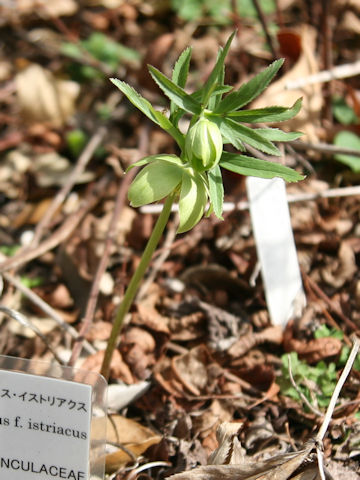
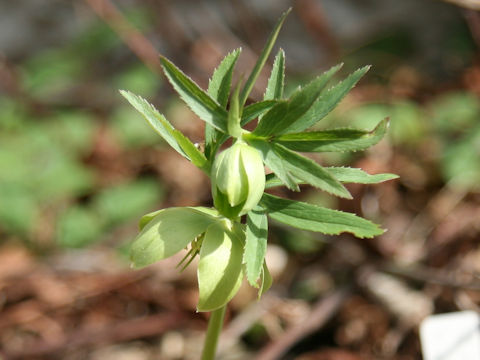
ヨーロッパの中南部、クロアチア南西部からスロベニア、イタリア北東部に分布しています。海岸山地の開けた砂礫地の斜面や草原、湿った雑木林などに生え、高さは20~45センチになります。葉は深緑色で、鳥足状に10~14個に分裂します。若葉の下面は有毛で銅色を帯びます。1月から4月ごろ、花茎を伸ばして、小さくうつむいたような緑色の花を咲かせます。種小名は、クロアチアのイストラ半島に因みます。 |
|
|
キンポウゲ科ヘレボルス属の多年草で、学名は Helleborus multifidus ssp. istriacus (syn. Helleborus multifidus f. istriacus)。英名は Istrian deeply-incised-leaved hellebore。 |
|
|
The Istrian deeply-incised-leaved hellebore (Helleborus multifidus ssp. istriacus) belongs to Ranunculaceae (the Buttercup family). It is a perennial herb that is distributed across south-central Europe, from southwestern Croatia through Slovenia to northeastern Italy. It grows on open, gravelly slopes and grasslands in coastal mountain ranges, as well as in moist mixed woodlands, reaching a height of 20 to 45 cm. The leaves are deep green and deeply lobed into 10 to 14 segments. The undersides of young leaves are hairy and have a coppery tint. From January to April, it extends a flower stalk and produces small, downward-facing green flowers. The specific epithet is derived from the Istra Peninsula in Croatia. |
|
|
茨城県つくば市「つくば実験植物園」にて、2026年03月07日撮影。 |
|
|

|
Shu Suehiro shu@botanic.jp
|
|