
|

|
 ひめひおうぎ (姫檜扇)
|
[Index]
[Back]
|
|
|
   |
|

|
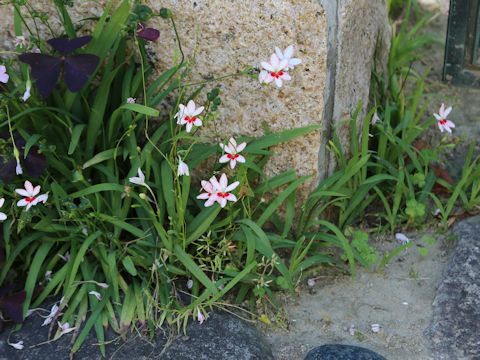
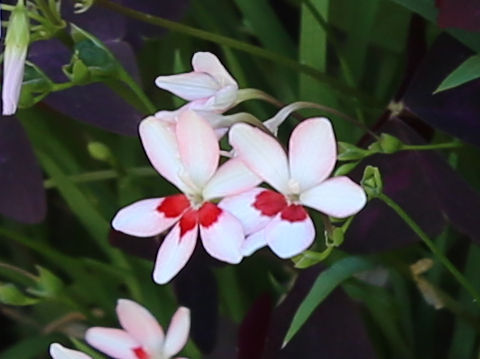
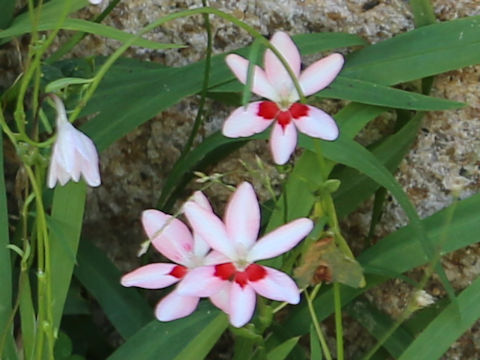
アフリカの東部、ケニアからモザンビーク、南アフリカ東部に分布しています。季節的に乾燥する熱帯バイオームに生え、高さは15~30センチになります。やや湿った環境を好み、冬には球茎まで枯れ落ち、春の終わりに再び成長して、夏に開花します。葉は線形で緑色、平らな扇状に広がります。南半球の10月から12月ごろ、花茎を伸ばして、直径2センチほどの花を咲かせます。花の色は多様に変化し、地色は赤色や白色、または淡い青色です。下部3個の花被片の基部には通常、赤色や紫色の濃い斑紋があります。これは、おそらくネクターガイドになっているのだと思われます。果実は蒴果で、種子の周りには白いエライオソームがあり、ミルメココリー(アリによる散布種子)による散布が行われています。 |
|
|
アヤメ科アサギスイセン属の多年草で、学名は Freesia laxa (syn. Lapeirousia cruenta、Anomatheca laxa)。英名は Flowering grass。 |
|
|
The Flowering grass (Freesia laxa) belongs to Iridaceae (the Iris family). It is a perennial herb that is native to eastern Africa, ranging from Kenya to Mozambique and eastern South Africa. It grows in seasonally dry tropical biomes and reaches a height of 15 to 30 cm. It prefers slightly moist environments; in winter, it withers down to the bulb, then regrows in late spring and blooms in summer. The leaves are linear and green, spreading out in a flat fan shape. From around October to December in the Southern Hemisphere, it extends a flower stalk and produces flowers about 2 cm in diameter. The flower colors vary widely, with a base color of red, white, or pale blue. The bases of the lower three perianth segments usually feature dark red or purple markings. These are thought to serve as nectar guides. The fruit is a capsule, and the seeds are surrounded by white elaiosomes, facilitating dispersal by myrmecochory (dispersal by ants). |
|
|
長崎市南山手町「祈りの丘絵本美術館」にて、2026年05月11日撮影。 |
|
|

|
Shu Suehiro shu@botanic.jp
|
|