
|

|
 ひめきせわた (姫着せ綿)
|
[Index]
[Back]
|
|
|
     |
|

|
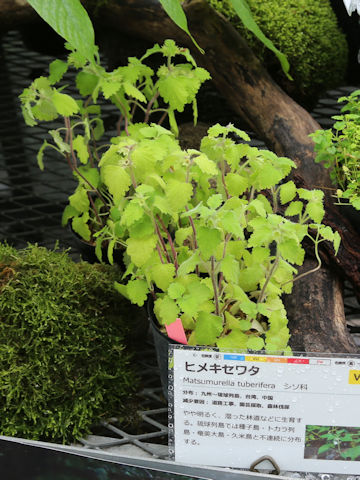
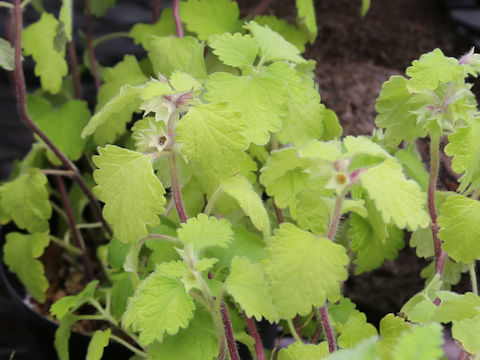
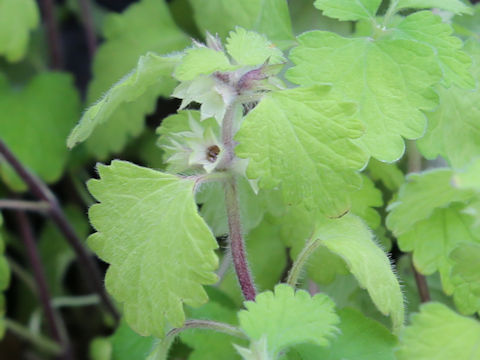
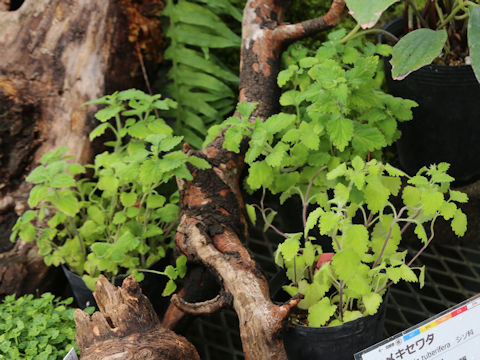
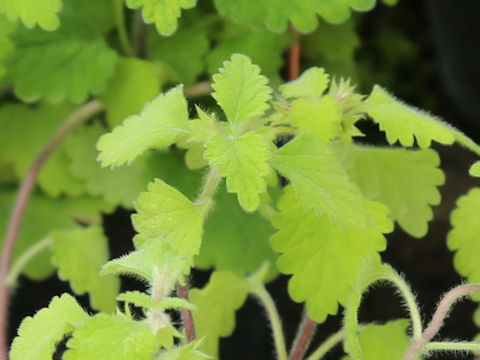
わが国の九州南部から種子島、トカラ列島の宝島、奄美群島の奄美大島、沖縄群島の久米島、それに台湾や中国の南部に分布しています。林縁の草地などに生え、高さは10~30センチになります。地中に細長い地下茎をのばし、その先に球形のイモをつくります。茎は四角形で、綿毛状の毛があります。葉は広卵形で、縁には粗い鋸歯があり、対生します。1月から5月ごろ、上部の葉腋に、白色でわずかに紅色の斑がある唇形花を、輪生して咲かせます。果実は三角形の小堅果です。環境省のレッドリストでは絶滅危惧II類(VU)に指定されています。台湾華語では「塊莖小野芝麻」、中国語では「塊莖小野芝麻(kuai gen xiao ye zhi ma)」と呼ばれます。 |
|
|
シソ科ヒメキセワタ属の多年草で、学名は Matsumurella tuberifera (syn. Lamium tuberiferum、Galeobdolon tuberiferum)。英名はありません。 |
|
|
The "Hime-kisewata" (Matsumurella tuberifera) belongs to Labiaceae (the Mint family). It is a perennial herb that is distributed from southern Kyushu to Tanegashima, Takarajima in the Tokara Islands, Amami-Oshima in the Amami Islands, Kumejima in the Okinawa Islands, as well as Taiwan and southern China. It grows in grassy areas along forest edges and reaches a height of 10 to 30 cm. It extends slender rhizomes underground, producing spherical tubers at their tips. The stems are square in cross-section and covered with downy hairs. The leaves are broadly ovate, with coarse serrations along the margins, and are arranged in opposite pairs. From January to around May, whitish flowers with faint reddish spots bloom in whorls from the upper leaf axils; these flowers are of the lamiate type. The fruit is a small, triangular achene. It is classified as Vulnerable (VU) in the Ministry of the Environment's Red List. In Taiwanese Chinese, it is called "塊莖小野芝麻", and "塊莖小野芝麻" (kuai gen xiao ye zhi ma) in Chinese. |
|
|
茨城県つくば市「つくば実験植物園」にて、2026年03月28日撮影。 |
|
|

|
Shu Suehiro shu@botanic.jp
|
|