
|

|
 ひめうず (姫烏頭)
|
[Index]
[Back]
|
|
|
       |
|

|
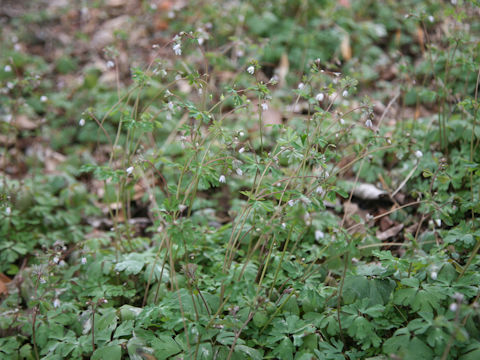
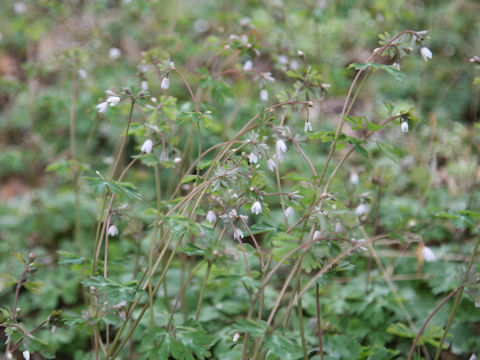
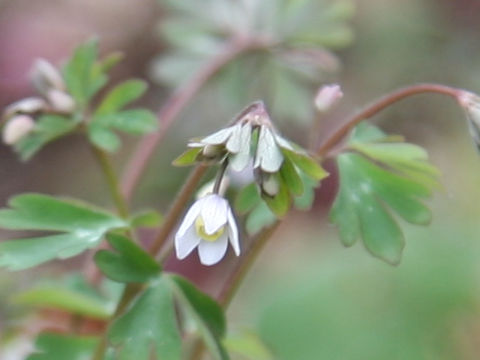
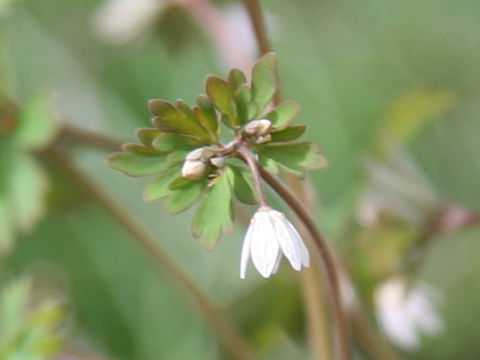
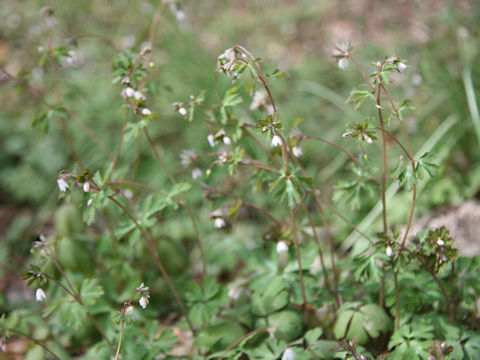
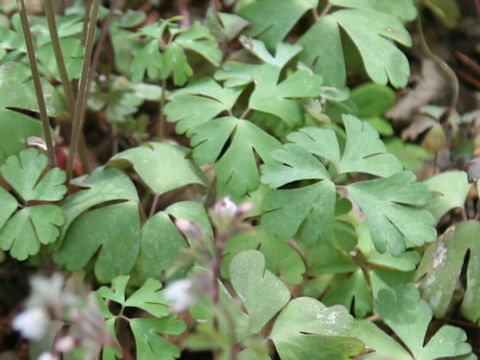
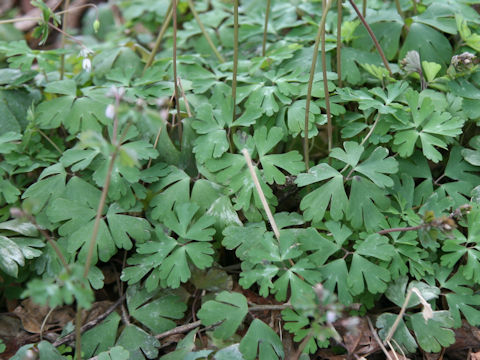
わが国の本州、関東地方以西から四国、九州、南西諸島、それに朝鮮半島南部や中国の中南部に分布しています。また台湾にも帰化しています。林縁や畑、道ばた、石垣などに生え、高さは20~35センチになります。茎は細くて軟毛があり、上部では分枝します。根生葉は3出複葉で、小葉は2~3裂します。3月から5月ごろ、枝先に小さな白色の花を下向きに咲かせます。花の直径は4~5ミリ、萼片は長楕円形で白色、わずかに紅色を帯びます。花弁の下部は筒状となり、きわめて短い距があります。果実は袋果で、上向きにつきます。台湾華語では「天葵」、中国語では「天葵(tian kui)」と呼ばれます。 |
|
|
キンポウゲ科ヒメウズ属の多年草で、学名は Semiaquilegia adoxoides (syn. Aquilegia adoxoides)。英名はありません。 |
|
|
The "Hime-uzu" (Semiaquilegia adoxoides) belongs to Ranunculaceae (the Buttercup family). It is a perennial herb that is distributed from the Kanto region of Honshu westward to Shikoku, Kyushu, the Nansei Islands in Japan, as well as southern Korea and central-southern China. It has also naturalized in Taiwan. It grows along forest edges, fields, roadsides, and stone walls, reaching a height of 20 to 35 cm. The stem is slender with soft hairs and branches near the top. The basal leaves are trifoliate, with leaflets 2 to 3-lobed. From March to May, small white flowers bloom downward at the branch tips. The flowers are 4-5 mm in diameter, with oblong sepals that are white, sometimes tinged with red. The lower part of the petals forms a tube with an extremely short spur. The fruit is a capsule that grows pointing upward. It is called "天葵" in Taiwanese Chinse, and "天葵" (tian kui) in Chinese. |
|
|
茨城県つくば市「つくば実験植物園」にて、2026年03月07日撮影。 |
|
|

|
Shu Suehiro shu@botanic.jp
|
|