
|

|
 ひめわたすげ (姫綿菅) |
[Index]
[Back]
|
|
|
  |
|

|
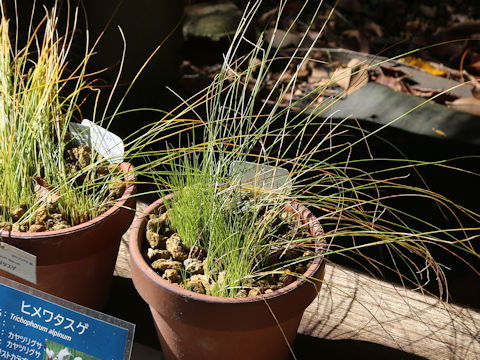
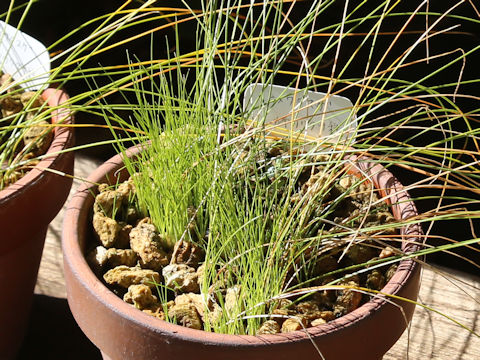
わが国の本州北部の八甲田山および北海道、朝鮮半島北部から中国の吉林省、それに千島列島、サハリン、カムチャッカ半島、北半球の亜寒帯に広く分布しています。高層湿原に生え、高さは20~30センチになり、根茎を多数伸ばします。茎には、鋭い3稜がありざらつきます。葉はほぼ退化して鞘と同化し、基部に集まります。6月から7月ごろ、茎の先端に赤褐色で小さな小穂をだします。6個の刺針状花被片は、開花後に長く伸長し、灰白色から白色の綿毛状になって小穂から突出します。和名は、ワタスゲに似ているけど、小穂の形が小さいためです。別名で「みやまさぎすげ(深山鷺菅)」。中国語では「鱗苞針藺(lin bao zhen lin)」と呼ばれます。 韓国語では「エギファンセプル(애기황새풀)」です。これは「赤ちゃん(エギ: 애기)」+「ワタスゲ(ファンセプル: 황새풀)」の合成語です。 |
|
|
カヤツリグサ科ヒメワタスゲ属の多年草で、学名は Trichophorum alpinum (syn. Eriophorum alpinum、Scirpus hudsonianus)。英名は Alpine bulrush。 |
|
|
The Alpine bulrush (Trichophorum alpinum) belongs to Cyperaceae (the Sedge family). It is a perennial herb that is widely distributed in the subarctic region of the Northern Hemisphere, including Mount Hakkoda in northern Honshu, Hokkaido, the northern part of the Korean Peninsula, Jilin Province in China, the Kuril Islands, Sakhalin, and the Kamchatka Peninsula. It grows in high-altitude bogs, reaches a height of 20 to 30 cm, and produces numerous rhizomes. The stems have three sharp ridges and are rough to the touch. The leaves are largely reduced and fused with the sheaths, clustering at the base. From around June to July, it produces small, reddish-brown spikelets at the tips of the stems. The six spiny perianth segments elongate significantly after flowering, becoming grayish-white to white and cottony, and protrude from the spikelets. Its Japanese name comes from its resemblance to "Watasuge" (Cotton-sedge), though its spikelets are smaller. Also known as "Miyama-sagi-suge". It is called "鱗苞針藺" (lin bao zhen lin) in Chinese. In Korean, it's called "ae-gi-hwang-sae-pul" (애기황새풀). This is a compound word consisting of "baby" (ae-gi: 애기) + "Cotton-sedge" (hwang-sae-pul: 황새풀). |
|
|
北海道札幌市中央区「北海道大学植物園」にて、2026年09月30日撮影。 |
|
|

|
Shu Suehiro shu@botanic.jp |
|