
|

|
 ひるぎもどき (漂木擬き)
|
[Index]
[Back]
|
|
|
    |
|

|
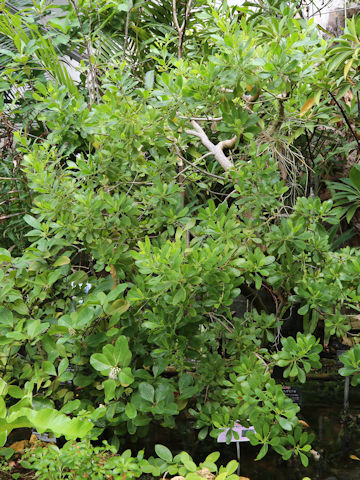
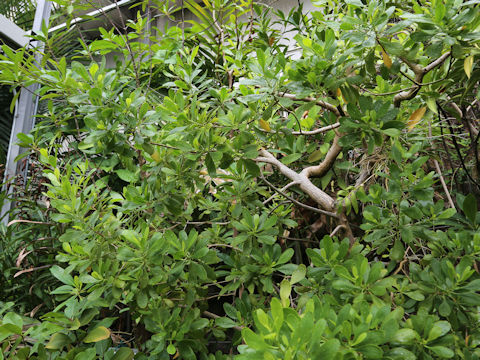
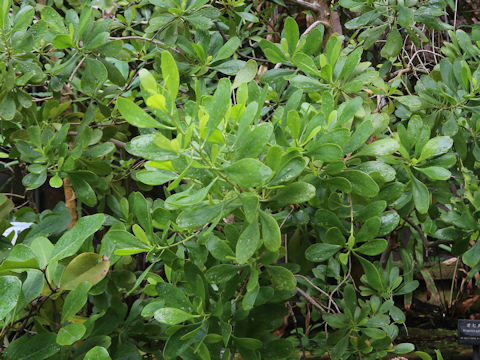
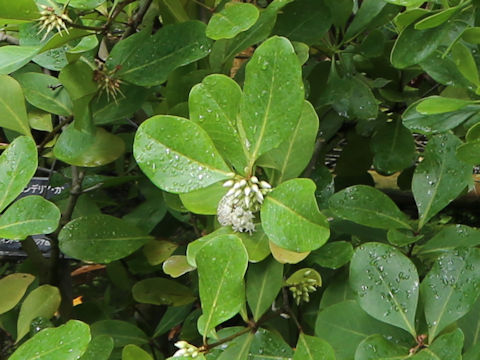
わが国の南西諸島、沖縄本島から台湾、中国南部、それに熱帯アジアを中心にアフリカ東部・ミクロネシア・オーストラリア北部に分布しています。汽水域にマングローブとして生え、高さは10メートルほどになります。幹は直立し、樹皮は褐色でざらつきます。また呼吸根は目立ちません、葉は多肉質で狭倒卵形、全縁またはときに波状の小鋸歯があります。3月から7月ごろ、葉腋に総状花序をだし、白色の小さな5弁花を咲かせます。果実は長楕円形の核果で、成熟すると赤褐色から黒褐色になり、水に浮くことで海流散布(水流散布)に適応しています。環境省のレッドリストでは、絶滅危惧IA類(CR)に分類されています。台湾華語では「欖李」、中国語では「欖李(lan li)」と呼ばれます。 |
|
|
シクンシ科ヒルギモドキ属の常緑小高木で、学名は Lumnitzera racemosa。英名は Lumnitzera。 |
|
|
The Lumnitzera (Lumnitzera racemosa) belongs to the family Combretaceae. It is a semi-tall deciduous tree that is distributed from the main island of Okinawa in the Nansei Islands of Japan, and Taiwan, southern China, and tropical Asia, as well as in eastern Africa, Micronesia, and northern Australia. It grows as a mangrove in brackish waters and reaches a height of about 10 m. The trunk is erect, and the bark is brown and rough. Its pneumatophores are inconspicuous; the leaves are fleshy and narrowly obovate, with entire margins or, occasionally, small wavy serrations. From March to July, it produces racemose inflorescences in the leaf axils, bearing small, white, five-petaled flowers. The fruit is a long-elliptical drupe that turns reddish-brown to blackish-brown when ripe; its ability to float on water enables it to be dispersed by ocean currents. It is classified as Critically Endangered (CR) on the Ministry of the Environment's Red List. It is called "欖李" in Taiwanese Chinese and "欖李" (lan li) in Chinese. |
|
|
茨城県つくば市「つくば実験植物園」にて、2026年03月28日撮影。 |
|
|

|
Shu Suehiro shu@botanic.jp
|
|