
|

|
 ひめすいかずら (姫忍冬)
|
[Index]
[Back]
|
|
|
    |
|

|
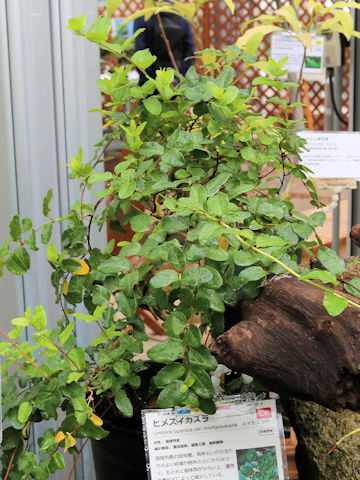
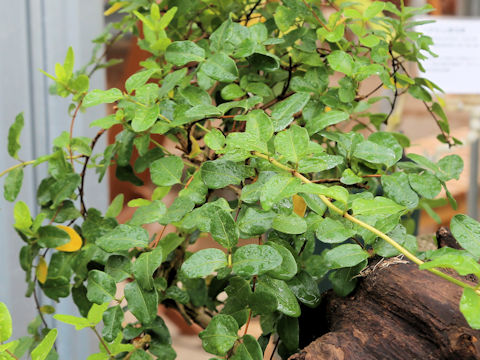
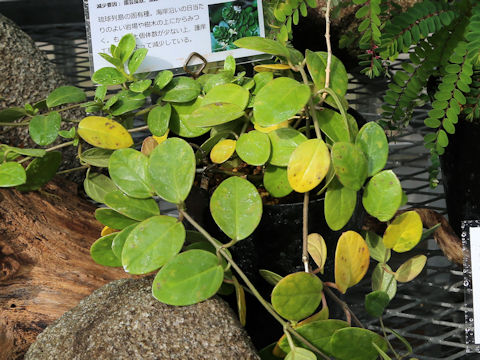
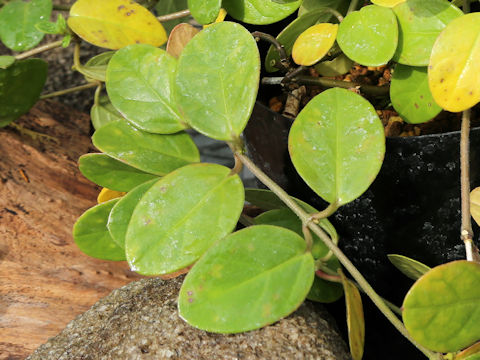
わが国の南西諸島に分布しています。具体的には奄美群島の徳之島と沖永良部島、沖縄群島の沖縄島と伊江島、宮古群島の宮古島、八重山群島の石垣島と西表島、与那国島の8つの島の固有分類群です。海岸近くにある石灰岩崖上の風衝地に生え、高さは1~2メートルになります。よく分枝します。葉は卵形から長楕円形でツヤがあり、厚くて対生します。5月から7月ごろ、上部の葉腋に白色の花を咲かせます。花は、時間が経つにつれて黄色に変わっていきます。果実は球形の液果で2個ずつ並んでつき、黒色に熟します。環境省のレットブックでは絶滅危惧IA類(CR)に分類されています。 |
|
|
スイカズラ科スイカズラ属の常緑または半落葉性の低木で、学名は Lonicera japonica var. miyagusukiana (syn. Lonicera miyagusukiana)。英名はありません。 |
|
|
The "Hime-suikazura" (Lonicera japonica var. miyagusukiana) belongs to Caprifoliaceae (the Honeysuckle family). It is a small evergreen or semi-deciduous tree that is distributed throughout Japan's Nansei Islands. Specifically, it is an endemic taxon found on eight islands: Tokunoshima and Okinoerabujima in the Amami Islands; Okinawa Island and Iejima in the Okinawa Islands; Miyakojima in the Miyako Islands; Ishigakijima, Iriomotejima and Yonagunijima in the Yaeyama Islands. It grows in wind-exposed areas on limestone cliffs near the coast and reaches a height of 1 to 2 m. It branches profusely. The leaves are ovate to oblong, glossy, thick, and arranged in opposite pairs. From around May to July, white flowers bloom in the upper leaf axils. The flowers turn yellow as time passes. The fruit is a spherical berry that grows in pairs and ripens to a black color. It is classified as Critically Endangered (CR) in the Ministry of the Environment's Red List. |
|
|
茨城県つくば市「つくば実験植物園」にて、2026年03月28日撮影。 |
|
|

|
Shu Suehiro shu@botanic.jp
|
|