
|

|
 ひゆな (ひゆ菜) |
[Index]
[Back]
|
|
|
      |
|

|
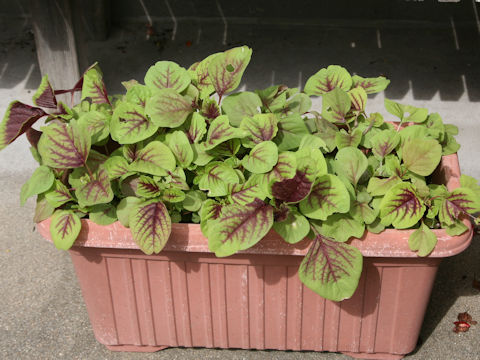
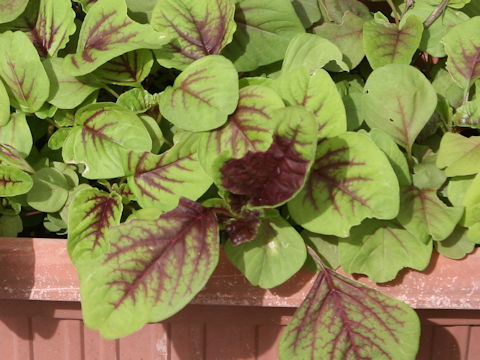
熱帯アメリカや熱帯アジアが原産です。高さは80~150センチになります。茎は直立し、やや分枝します。葉は、一部が赤色のものだけでなく、葉が緑色だけのもの、茎も含めて全体が赤色をしているものなど、赤の度合いは様々です。メキシコやペルーなどではインカ文明のころから穀物として栽培され、中国南部やインドネシア、東南アジア地域では葉と茎を食べるように栽培されています。「はげいとう」の亜種で、その食用種としてもいいかもしれません。この「ひゆな」はアクが少なく、「ほうれんそう」のような癖がないので、とても食べやすいものです。標準和名は「ひゆ(莧)」です。別名で「バイアム」とも呼ばれますが、これはインドネシア語で「ほうれんそう」を意味します。中国語では「莧菜(xian cai)」と呼ばれます。C4植物(C4型光合成を行う植物)です。 韓国語では「ピルム(비름)」です。これは生のままだと少し青臭いことから、「生臭い(ピリンネ: 비린내)」草という意味で名付けられたと言われています。 写真上・中2は、一部が赤色の「Bayam Loreng」、 中1・中3は、全体が赤色の「Bayam Merah Abbang」、 全体が緑色なのは、「Bayam Hijau Samudra」と呼ばれます。 |
|
|
ヒユ科ヒユ属の一年草で、学名は Amaranthus tricolor ssp. mangostanus (syn. Amaranthus mangostanus)。英名は Chinese spinach。 |
|
|
The Chinese spinach (Amaranthus tricolor spp. mangostanus) belongs to Portulacaceae (the Purslane family). It is an annual herb that is native to tropical America and tropical Asia. It grows to a height of 80 to 150 cm. The stem is erect and slightly branched. The leaves vary in their degree of redness: some have only partially red leaves, others have entirely green leaves, and still others are entirely red, including the stem. In countries like Mexico and Peru, it has been cultivated as a grain crop since Inca times. In southern China, Indonesia, and Southeast Asia, it is grown for its edible leaves and stems. It is a subspecies of "Chinese spinach" (Amaranthus tricolor var. tricolor) and could also be considered an edible variety. This Chinese spinach has less bitterness and lacks the strong flavor typical of "spinach", making it very easy to eat. The standard Japanese name is "Hiyu (莧). It is also known by the alternative name "Bayam", which means "spinach" in Indonesian. In Chinese, it is called "莧菜" (xian cai). It is a C4 plant (Plants with C4-type photosynthesis). In Korean, it's called "pi-reum" (비름). It is said that this plant was named "bi-rin-nae" (비린내), meaning "fishy-smelling" grass, because it has a slightly fishy odor when raw. |
|
|
[上・中1] 千葉県香取市大角にて、2017年01月25日撮影。 [中2・中3] 同上にて、2017年02月16日撮影。 [中4・下] 宮城県大河原町大谷にて、2025年09月29日撮影。 |
|
|

|
Shu Suehiro shu@botanic.jp |
|