

|
 ほおのき (朴の木) |
|
|
|
-- もっと見る(Show more)--
-- 閉じる(Close) --
|
|
|
|

|
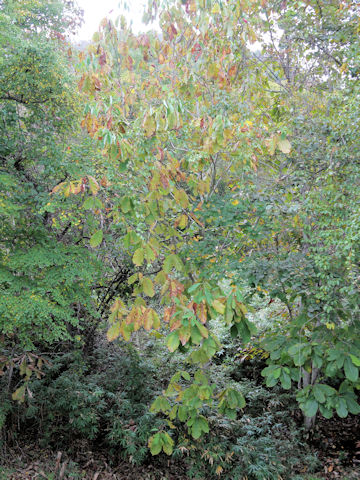
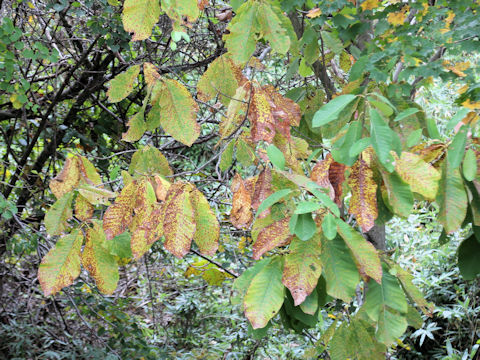
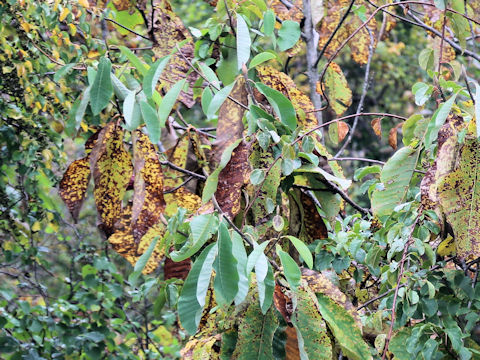
わが国の各地をはじめ、千島列島に分布しています。丘陵や山地に生え、高さは30メートルほどになります。大きな倒卵形から倒卵状長楕円形の葉は互生し、枝先に集まり車輪のように見えます。5月から6月ごろ、芳香のある白色または淡い黄白色の花を咲かせます。古くは「ほおがしわ(朴柏)」と呼ばれ、葉に食物を盛るのに使われました。いまでも岐阜県では「朴葉味噌」として利用されています。これは朝鮮半島や中国東北部で、公園樹として栽培されています。中国語では「日本厚朴(ri ben hou po)」と呼ばれます。 韓国語では「イルボンモンニョン(일본목련)」です。これは「日本(イルボン: 일본)」+「木蓮(モンニョン: 목련)」の合成語です。 |
|
|
モクレン科モクレン属の落葉高木で、学名は Magnolia obovata(syn. Magnolia hypoleuca、Houpoea obovata)。英名は Japanese white-bark magnolia。 |
|
|
The Japanese white-bark magnolia (Magnolia obovata) belongs to Magnoliaceae (the Magnolia family). It is a tall deciduous tree that is distributed throughout Japan and the Kuril Islands. This tree grows in the hills and mountains and can reach about 30 m in height. The leaves are large obovate to obovate-oblong, alternate, wheeled at the terminal branches. The fragrant white to pale yellowish white flowers come in May to June. The leaves had been used for serving rice in ancient days, and are used for "Hooba-miso" (Fermented covered with the leaves) in Gifu prefecture nowadays. It is cultivated as an ornamental tree in the Korean Peninsula and northeastern China. It is called "日本厚朴" (ri ben hou po) in Chinese. In Korean, it's called "Il-bon-mong-nyeon" (일본목련). This is a compound word consisting of "Japan" (Il-bon: 일본) + "magnolia" (mong-nyeon: 목련). |
|
|
[上] 福島県北塩原村「デコ平湿原」にて、2009年06月28日撮影。 [中14~中16] 同上にて、2014年09月07日撮影。 [中1~中3] 大阪府河内長野市滝畑「滝畑ダム」にて、2006年05月15日撮影。 [中4・中5] 岐阜県八百津町久田見にて、2007年06月07日撮影。 [中6・中7] 大阪府交野市「大阪市大付属植物園」にて、2006年11月30日撮影。 [中8・中10] 同上にて、2007年03月10日撮影。 [中9] 長野県軽井沢町「軽井沢町植物園」にて、 2010年05月15日撮影。 [中11] 群馬県中之条町四万にて、2011年10月02日撮影。 [中12・中13] 千葉県成田市「千葉県花植木センター」にて、2013年04月12日撮影。 [中17・中18] 山形県小国町小玉川にて、2015年05月04日撮影。 [中19~中21] 同上にて、2015年05月24日撮影。 [中22~中24] 同上にて、2016年04月23日撮影。 [中25・中26] 同上にて、2017年06月06日撮影。[中29~中31] 同上にて、2018年03月28日撮影。 [中35~中37] 同上にて、2019年05月22日撮影。 [中47~中49] 同上にて、2022年05月05日撮影。 [中52・中53] 同上にて、2022年05月22日撮影。 [中27・中28] 山形県小国町小玉川「温身平」にて、2017年10月21日撮影。 [中32~中34] 大分県別府市東山にて、2018年04月27日撮影。 [中38・中39] 宮城県川崎町「みちのく湖畔公園」にて、2020年02月02日撮影。 [中40~中42] 北海道千歳市「支笏湖」にて、2020年09月22日撮影。 [中64~65・下] 同上にて、2026年10月01日撮影。 [中43・中44] 宮城県仙台市泉区「宮城県県民の森」にて、2021年03月09日撮影。 [中45・中46] 宮城県川崎町支倉「北山」にて、2021年05月11日撮影。 [中50・中51] 宮城県川崎町支倉「釜房湖」にて、2022年05月17日撮影。 [中54~中57] 山形県天童市「天童公園」にて、2023年09月19日撮影。 [中58・中59] 福島県白河市「天狗山」にて、2024年12月12日撮影。 [中60・中61] 宮城県大河原町堤南「手倉森山」にて、2026年02月15日撮影。 [中62・中63] 宮城県村田町足立にて、2026年03月17日撮影。 |


|
|

|
Shu Suehiro shu@botanic.jp |