 |


|

|
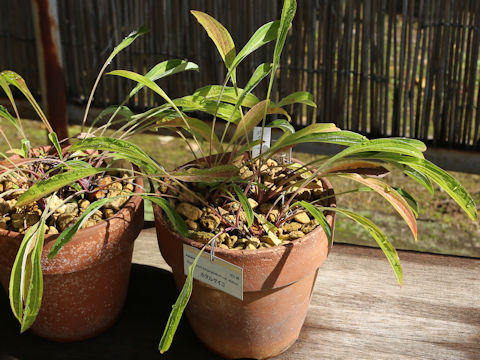
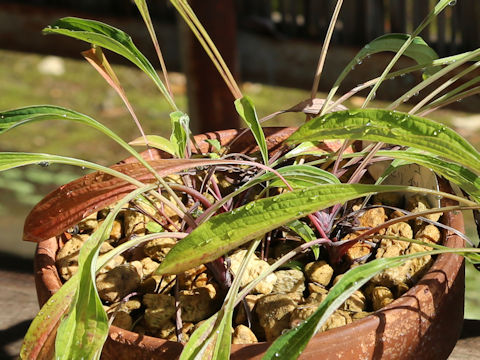
わが国の各地をはじめ、朝鮮半島や中国に分布しています。山地の日当たりのよい草地や林縁に生え、高さは1~1.5メートルになります。根生葉は長楕円形で、長い柄があります。セリ科ではめずらしく葉に切れ込みがありません。7月から9月ごろ、枝先に複散形花序をだして、淡黄色の小さな花を咲かせます。母種の「みしまさいこ(三島柴胡)」と同様、根は漢方薬とされます。中国語では「大葉柴胡(da ye chai hu)」と呼ばれます。
韓国語では「ケシホ(개시호)」です。これは「犬(ケ: 개)」+「柴胡(シホ: 시호)」の合成語です。薬効が弱かったり用途が限られていたことから、接頭辞の「犬」がついています。
|
|
|
セリ科ミシマサイコ属の多年草で、学名は Bupleurum longiradiatum ssp. sachalinense var. elatius (syn. Bupleurum longiradiatum var. elatius)。英名はありません。
|
|
|
The "Hotaru-saiko" (Bupleurum longiradiatum ssp. sachalinense var. elatius) belongs to Apiaceae (the Carrot family). It is a perennial herb that is native throughout Japan, the Korean Peninsula and China. This herb grows in montane sunny grasslands or forest edges, and can reach 1-1.5 m in height. The basal leaves are oblong with long petioles. The leaves are not notched exceptionally among the Carrot family. The compound umbels are borne on the terminal branches, and the small, pale yellow flowers bloom from July to September. The rootstocks are used as a herbal medicine. It is called "大葉柴胡" (da ye chai hu) in Chinese.
In Korean, it's called "gae-si-ho" (개시호). This is a compound word consisting of "dog" (gae: 개) + "Bupleurum root" (si-ho: 시호). Because its medicinal effects were weak or its uses were limited, it has the prefix "gae" (dog) attached to its name.
|
|
|
[上・中1] 北海道北見市常呂町「ワッカ原生花園」にて、2009年08月04日撮影。(photo by Aya Suehiro)
[中2・下] 北海道札幌市中央区「北海道大学植物園」にて、2026年09月30日撮影。
|

 ほたるさいこ (蛍柴胡)

 shu@botanic.jp