
|

|
 ギーマ
ギーマ
|
[Index]
[Back]
|
|
|
      |
|

|
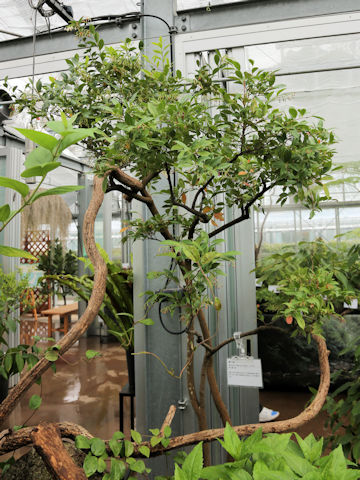
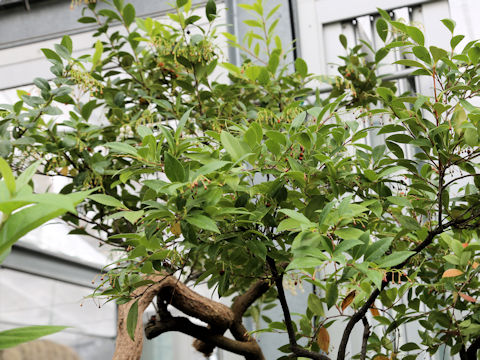
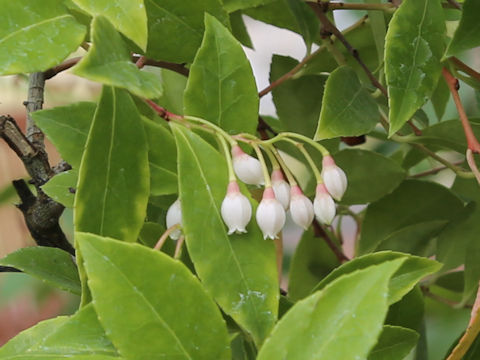
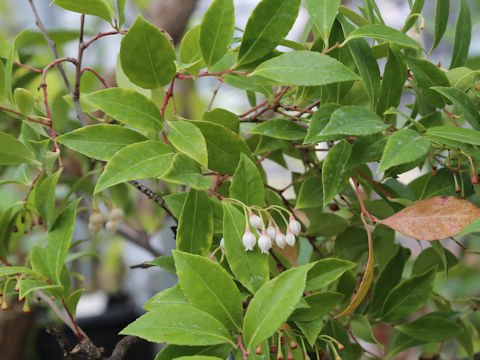
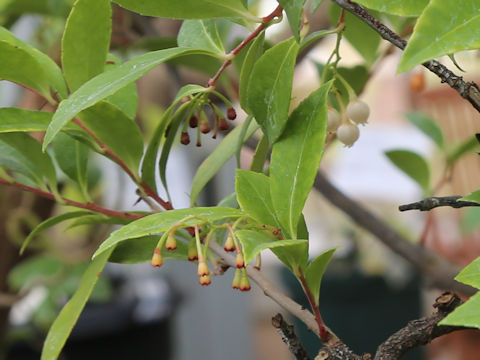
わが国の南西諸島から台湾に分布しています。山地の林内や林縁、草地などに生え、高さは1~3メートルになります。根もとからよく分枝し、枝は丸くて樹皮は平滑、若枝は赤褐色をしている。葉は楕円形で革質、縁には鋭い鋸歯があり、互生します。2月から4月ごろ、上部の葉腋から総状花序をだし、白色でやや赤みを帯びた花を、下垂して咲かせます。花冠は小型の壺形から鐘形で、先端が浅く4~5裂します。果実は球形の液果で、黒色に熟して、甘酸っぱく、食べられます。和名は、沖縄の方言に因ります。また別名で「ひめしゃしゃんぼ(姫小小ん坊)」とも呼ばれます。台湾華語では「大葉越橘」です。 |
|
|
ツツジ科スノキ属の常緑低木で、学名は Vaccinium wrightii。英名は Formosan blue berry。 |
|
|
The Formosan blue berry (Vaccinium wrightii) belongs to Ericaceae (the Heath family). It is a small evergreen tree that is distributed from Japan's Nansei Islands to Taiwan. It grows in mountainous forests, forest edges, and grasslands, reaching a height of 1 to 3 m. It branches profusely from the base; the branches are round with smooth bark, and young branches are reddish-brown. The leaves are elliptical and leathery, with sharp serrations along the margins, and are arranged alternately. From around February to April, racemes emerge from the upper leaf axils, bearing white, slightly reddish flowers that hang downward. The corolla is small, ranging from urn-shaped to bell-shaped, with a shallow 4-5 lobed tip. The fruit is a spherical berry that ripens to black; it is sweet and sour and edible. The Japanese name "Guima" is derived from the Okinawan dialect. It is also known by the alternative name "Hime-sha-shanbo". In Taiwanese Chinese, it is called "大葉越橘". |
|
|
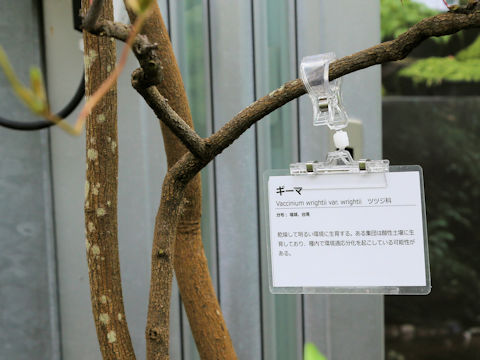
茨城県つくば市「つくば実験植物園」にて、2026年03月28日撮影。 |
|
|

|
Shu Suehiro shu@botanic.jp
|
|