
|
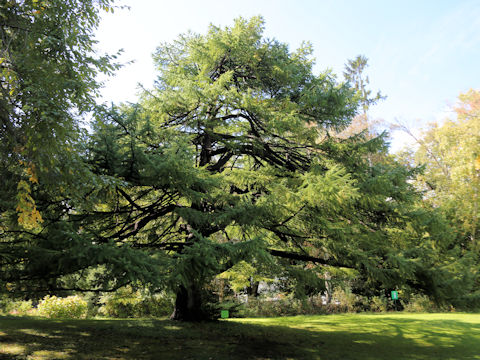
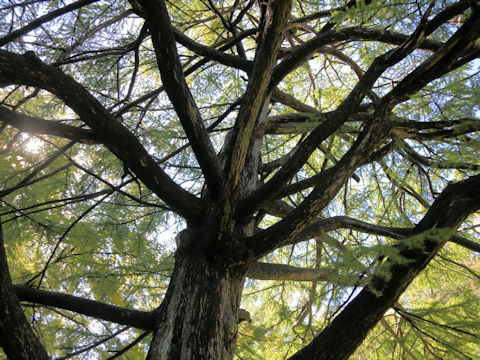
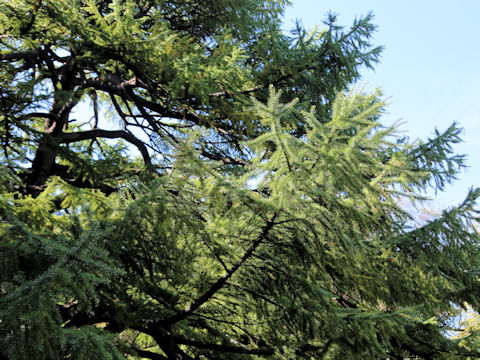
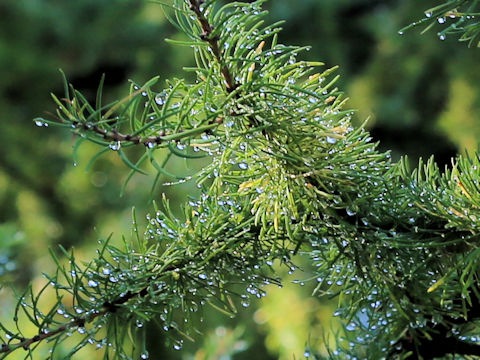
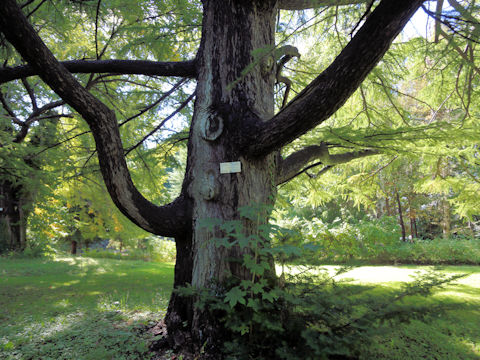
The Kuril larch (Larix gmelinii var. japonica) belongs to Pinaceae (the Pine family). It is a tall decoduous tree that is found from the southern part of Japan's Kuril Islands to southern Sakhalin in Russia. It is considered a subspecies of the Daurian larch, which is widely distributed throughout the subarctic region of Northeast Asia. Under optimal conditions, it can reach a height of 30 m and a trunk diameter of 80 cm. The bark is dark gray to blackish-brown; as the tree ages, it cracks into scales and peels off. The main branches are thick and extend mostly horizontally, while the twigs do not droop much. The leaves are needle-like, bright green, and narrowly linear, 15-30 mm long, arranged in bundles of 25-40. The tree is monoecious and blooms around May. The fruit is a cone, 15-30 mm in length and elliptical in shape; it ripens from August to September and turns brownish-red. It is used for afforestation in subalpine zones of northern Hokkaido and for reforestation in areas undergoing soil and watershed conservation projects. The "Gui" in the Japanese name derives from "kuy", the Ainu word for this species. It is also known as "Shikotan-matsu".
|


 グイまつ (グイ松)

 shu@botanic.jp