

|
 かんぼく (肝木) |
|
|
|
-- もっと見る(Show more)--
-- 閉じる(Close) --
|
|
|
|

|
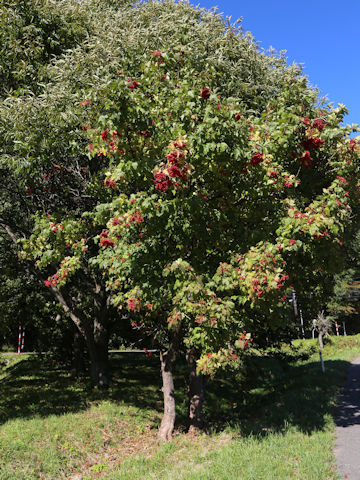
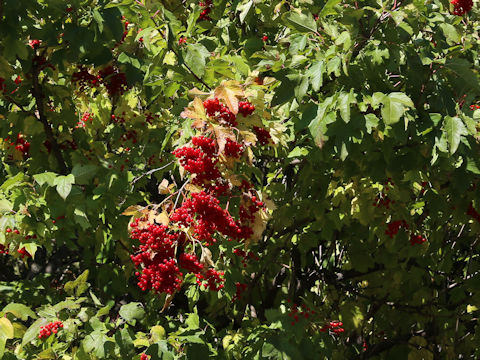
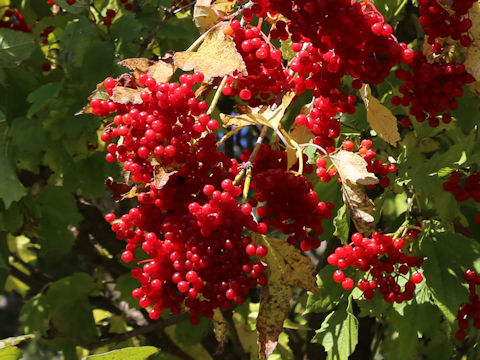
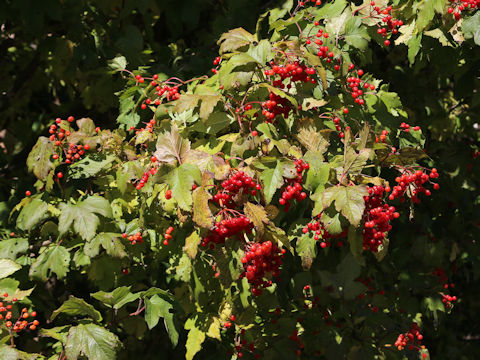
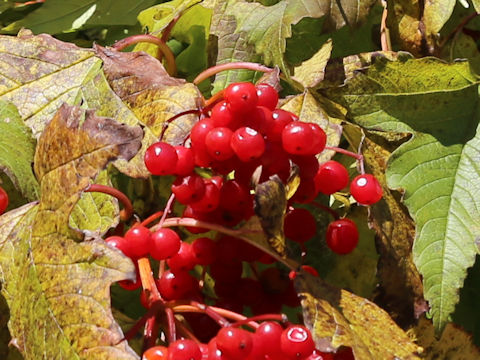
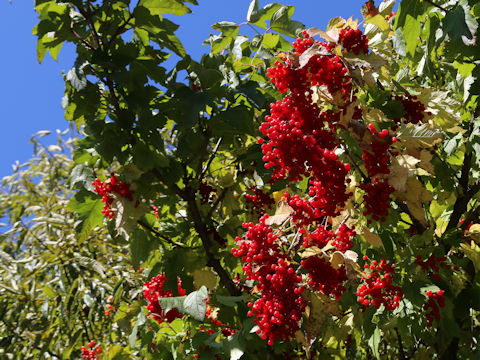
わが国の本州、中部地方以北から北海道、それに千島列島やサハリン、朝鮮半島、中国に分布しています。山地の林内に生え、高さは6メートルほどになります。葉は広卵形で3中裂し、対生します。5月から7月ごろ、枝先に散房花序をだし、中心部に両性花、周囲に白い装飾花を咲かせます。装飾花はふつう5深裂して平開します。果実は核果で、秋に赤く熟します。ただこの果実は非常にまずく、食用には適しません。別名で「鳥食わず」と呼ばれることもあるそうです。中国語では「鶏樹条(ji shu tiao)」と呼ばれます。 韓国語では「ペクダンナム(백당나무)」です。語源の由来には諸説ありますが、京畿道の方言に由来するというのが有力です。それは白い花が咲くことと、葉の形がコウゾの葉に似ていることから、「白楮(ペクダク: 백닥나무 )」と呼ばれたものが「白当(ペクダン: 백당나무)」になったという説です。 |
|
|
スイカズラ科ガマズミ属の落葉低木で、学名は Viburnum opulus var. calvescens (syn. Viburnum opulus var. sargentii)。英名は Guelder rose。 |
|
|
The Guelder rose (Viburnum opulus var. calvescens) belongs to Caprifoliaceae (the Honeysuckle family). It is a small deciduous tree that is distributed northward from Chubu district of Hoshu to Hokkaido of Japan, as well as the Kuril Islands and Sakhalin. This tree grows in montane woodlands and can reach about 6 m in height. The leaves are broad ovate, trilobate and opposite. The corymbs are borne on the terminal branches and bloom white flowers. The bisexual flowers are at center and the neuter flowers are at around the periphery. The neuter flowers are usually five lobate and spread out. The fruits are drupes and ripen red in fall. However, this fruit tastes very bad and is not suitable for human consumption. I've heard it's sometimes called "Tori-kuwazu" (birds don't eat it). It is called "鶏樹条" (ji shu tiao) in Chinese. In Korean, it's called "baek-dang-na-mu" (백당나무). While there are various theories regarding its etymology, the most widely accepted view is that it originates from a dialect of Gyeonggi Province. One theory suggests that a plant called "white kozo" (baek-dang-na-mu: 백닥나무), so named because it bears white flowers and its leaves resemble those of the kozo tree, eventually came to be known as "white dang" (baek-dang-na-mu: 백당나무). |
|
|
[上・中1] 岐阜県高山市丹生川町久手にて、2005年06月26日撮影。 [中2・中3] 大阪府交野市「大阪市大付属植物園」にて、2006年05月12日撮影。 [中4] 長野県塩尻市「高ボッチ高原」にて、2007年07月11日撮影。 [中5・中6] 長野県軽井沢町「軽井沢町植物園」にて、2008年10月18日撮影。 [中11・中12] 同上にて、2010年07月24日撮影。 [中7・中8] 栃木県日光市中宮祠「戦場ヶ原」にて、2010年06月26日撮影。 [中9・中10] 群馬県片品村戸倉にて、2010年06月27日撮影。 [中13~中15] 福島県磐梯町更科にて、2012年06月23日撮影。 [中16~中23] 山形県白鷹町高玉にて、2018年05月24日撮影。 [中24~中26] 山形市門田にて、2018年06月08日撮影。 [中27~中29] 山形県山辺町北作にて、2018年06月08日撮影。 [中30~中33] 北海道旭川市「旭山三浦庭園」にて、2020年09月20日撮影。 [中34~38・下] 福島県猪苗代町若宮にて、2026年10月17日撮影。 |


|
|

|
Shu Suehiro shu@botanic.jp |