
|

|
 かわつるも (川蔓藻)
|
[Index]
[Back]
|
|
|
  |
|

|
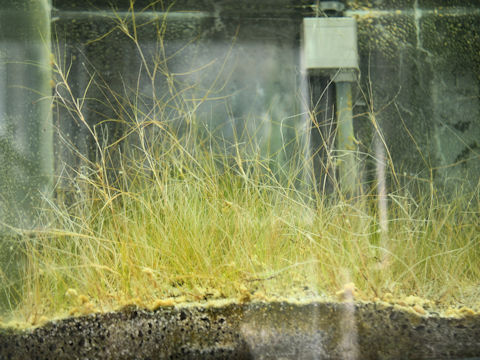
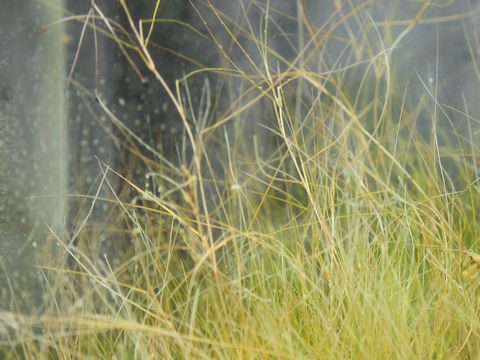
世界に広く分布しています。淡水と海水の混ざる汽水域の塩性湿地などに生え、底質に浅く根を張った根茎から生育します。植物体は非常に細く、葉は糸状で長さ5~10センチほどで、水中を漂うように群生します。6月から8月ごろ、葉腋から伸びた花茎の先に2個の目立たない淡緑色の花を咲かせます。受粉は水面で行われる「水媒花」で、花後、花茎は水中に没し、黒い卵球形の果実ができます。台湾華語では「流蘇菜」、中国語では「川蔓藻(chuan man zao)」と呼ばれます。 |
|
|
カワツルモ科カワツルモ属の多年草で、学名は Ruppia maritima。英名は Widgeon grass、Beaked tasselweed。 |
|
|
The Widgeon grass (Ruppia maritima) belongs to the family Ruppiaceae. It is a perennial herb that is widely distributed throughout the world. It grows in brackish wetlands where freshwater and seawater mix, developing from rhizomes that spread shallowly through the substrate. The plant is very slender, with thread-like leaves about 5 to 10 cm long, and it grows in clusters that appear to float in the water. From June to August, two inconspicuous pale green flowers bloom at the tips of flower stalks that extend from the leaf axils. Pollination occurs on the water’s surface, making it an "hydrophilous flower". After flowering, the flower stalks sink beneath the water, and black, ovoid fruits develop. In Taiwanese Chinese, it is called "流蘇菜", and "川蔓藻" (chuan man zao) in Chinese. |
|
|
茨城県つくば市「つくば実験植物園」にて、2026年03月07日撮影。 |
|
|

|
Shu Suehiro shu@botanic.jp
|
|