

|
 こからまつ (小落葉松) |
|
|
     |
|

|
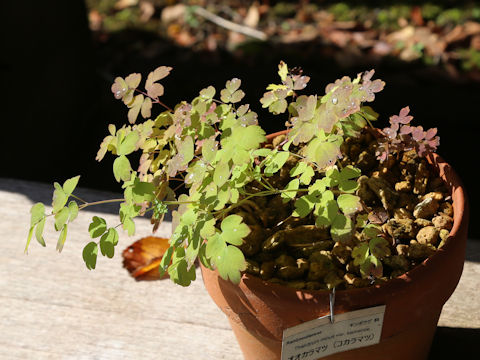
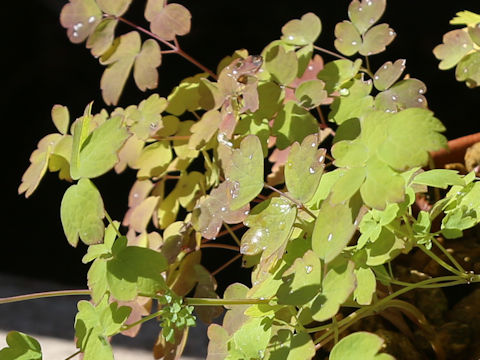
わが国の北海道から本州中北部、四国、それに朝鮮半島北部、中国の新疆ウイグル、西アジアからヨーロッパに分布しています。亜高山帯から高山帯に生え、高さは30~100センチになります。葉は3~4回3出複葉です。7月から8月ごろ、円錐花序に淡い黄白色の花を疎らに咲かせます。「あきからまつ(秋落葉松)」の一型ですが、花柄が1~5センチと長いのが特徴です。別名で、正反対の「おおからまつ(大落葉松)」とも呼ばれます。中国語では「長梗亞歐唐松草(chang geng ya ou tang song cao)」と呼ばれます。 韓国語では「キンッコジチョムックォンエダリ(긴꼭지좀꿩의다리)」です。これは「長い茎(キンッコジ: 긴꼭지)」+「小さな(チョム: 좀)」+「カラマツソウ(ックォンエダリ: 꿩의다리)」の合成語です。「ックォンエダリ」は「雉の脚」という意味で、細く伸びる茎の姿がキジの脚に似ていることから名付けられました。 |
|
|
キンポウゲ科カラマツソウ属の多年草で、学名は Thalictrum minus var. stipellatum (syn. Thalictrum minus var. kemense、Thalictrum minus ssp. elatum)。英名はありません。 |
|
|
The "Ko-karamatsu" (Thalictrum minus var. stipellatum) belongs to Ranunculaceae (the Buttercup family). It is a perennial herb that is found in Japan-from Hokkaido to central and northern Honshu and Shikoku-as well as in the northern part of the Korean Peninsula, the Xinjiang Uyghur Region in China, and from West Asia to Europe. This herb grows from the subalpine zone to the alpine zone and can reach a height of 30-100 cm. The leaves are triternate to tetraternate compound. The pale yellowish white flowers bloom sparsely on the panicles from July to August. It is a type of "Aki-karamatsu" (Thalictrum minus var. hypoleucum), but it is characterized by a long peduncle of 1 to 5 cm. Another name is "Oo-karamatsu", which has the opposite meaning. It is called "長梗亞歐唐松草" (chang geng ya ou tang song cao) in Chinese. In Korean, it's called "kin-kkok-ji-jom-ggwong-eui-da-ri" (긴꼭지좀꿩의다리). This is a compound word consisting of "long stem" (kin-kkok-ji: 긴꼭지) + "small" (jom: 좀) + "Karamatsu-so" (ggwong-eui-da-ri: 꿩의다리). "ggwong-eui-da-ri" means "pheasant's leg", and it was given this name because the slender, elongated stems resemble a pheasant's legs. |
|
|
[上・中1~2] 石川県吉野谷村中宮にて、2004年08月07日撮影。 [中3・下] 北海道札幌市中央区「北海道大学植物園」にて、2026年09月30日撮影。 |
|
|

|
Shu Suehiro shu@botanic.jp |