
|

|
 こみだけしだ (古見岳羊歯)
|
[Index]
[Back]
|
|
|
   |
|

|
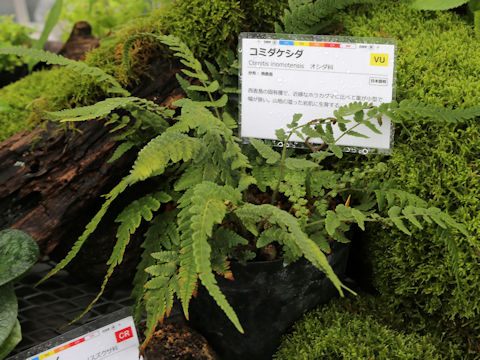
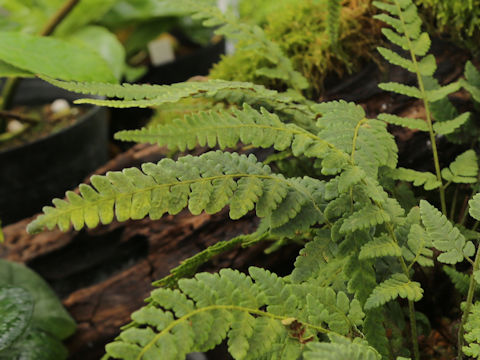
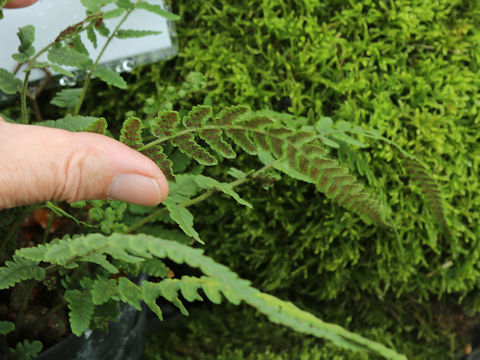
わが国の八重山群島にある西表島の固有種です。山地の薄暗く湿った岩壁に生え、高さは10~20センチになります。葉は長楕円状卵形で、3回羽状深裂します。一番下の羽片は最も大きく、浅く切れ込んで基部に合着した1対の小羽片があります。胞子嚢群は裂片の中間につき、包膜は円腎形で全縁です。近縁の「ほらかぐま(洞かぐま)」に比べて、葉が小型で幅が狭いのが特徴です。環境省のレッドリストでは絶滅危惧II類(VU)に指定されています。 |
|
|
オシダ科カツモウイノデ属の常緑シダ類で、学名は Ctenitis iriomotensis (syn. Ctenitis eatonii var. iriomotensis)。英名はありません。 |
|
|
The "Komidake-shida" (Ctenitis iriomotensis) belongs to the family Dryopteridaceae. It is an evergreen fern that is an endemic species found on Iriomote Island in Japan's Yaeyama Islands. It grows on dim, damp rock faces in mountainous areas and reaches a height of 10 to 20 cm. The leaves are oblong-ovate and deeply pinnately lobed three times. The lowest pinna is the largest, and there is a pair of small pinnae that are shallowly lobed and fused at the base. The sori are located in the middle of the lobes, and the indusia are reniform with entire margins. Compared to the closely related "Hora-kaguma" (Ctenitis eatonii), it is characterized by smaller, narrower leaves. It is classified as Vulnerable (VU) in the Ministry of the Environment's Red List. |
|
|
茨城県つくば市「つくば実験植物園」にて、2026年03月28日撮影。 |
|
|

|
Shu Suehiro shu@botanic.jp
|
|