
|

|
 こばのみやまのぼたん (小葉の深山野牡丹)
|
[Index]
[Back]
|
|
|
   |
|

|
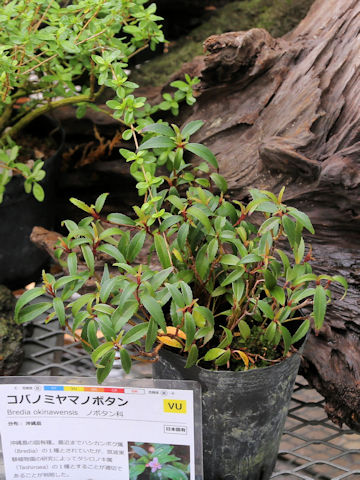
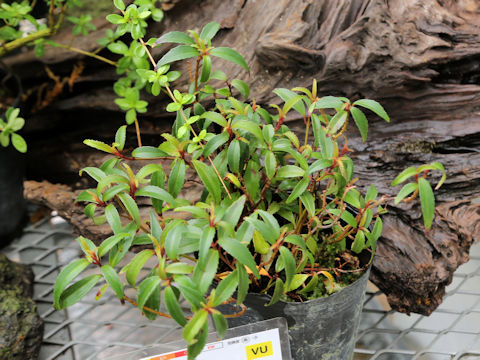
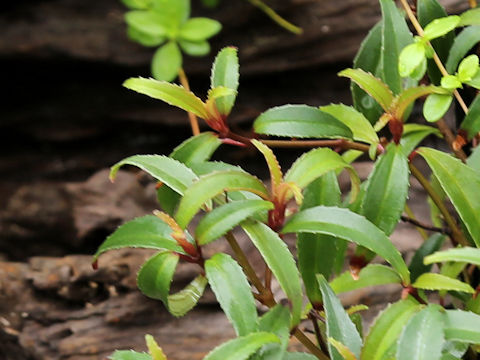
わが国の沖縄群島にある沖縄島の固有種です。北部のやんばる(山原)の明るい林縁や斜面、川沿いなどに生え、高さは50~100センチになります。葉は長楕円形でうすい革質、縁は鋸歯縁からやや全縁で、両面無毛、互生します。葉の表面の3行脈が目立ちます。6月から7月ごろ、枝先に集散花序をだし、花を3~7個咲かせます。花弁は桃紅色で4枚あり、まれに白花もあります。果実は洋梨形の蒴果です。別名で「たしろのき(田代の木)」とも呼ばれます。環境省のレッドリストでは絶滅危惧II類(VU)に指定されています。 かつてはハシカンボク属(Bredia)に分類されていたものが、つくば植物園などの研究により、2019年にタシロノキ属として独立させるのが適切であると判明しました。 |
|
|
ノボタン科タシロノキ属の常緑小低木で、学名は Tashiroea okinawensis (syn. Bredia okinawensis)。英名はありません。 |
|
|
The "Kobano-miyama-nobotan" (Tashiroea okinawensis) belongs to Melastmataceae (the Melastome family). It is an evergreen shrub that is an endemic species found on Okinawa Island in Japan's Okinawa Islands. It grows in the northern Yambaru region, along the edges of bright forests, on slopes, and along rivers, reaching a height of 50 to 100 cm. The leaves are oblong, thin, and leathery; their margins range from serrated to slightly entire; they are glabrous on both surfaces and arranged alternately. Three prominent veins run along the upper surface of the leaf. From around June to July, it produces corymbs at the tips of its branches, bearing 3 to 7 flowers. The flowers have four pinkish-red petals, though white flowers are occasionally found. The fruit is a pear-shaped capsule. It is also known by the alternative name "Tashiro-no-ki". It is designated as Vulnerable (VU) on the Ministry of the Environment’s Red List. Although it was once classified in the genus Bredia, research conducted at institutions such as the Tsukuba Botanical Garden determined in 2019 that it should be classified as a separate genus, Tashiroea. |
|
|
茨城県つくば市「つくば実験植物園」にて、2026年03月28日撮影。 |
|
|

|
Shu Suehiro shu@botanic.jp
|
|