
|

|
 こせりばおうれん (小芹葉黄蓮)
|
[Index]
[Back]
|
|
|
   |
|

|
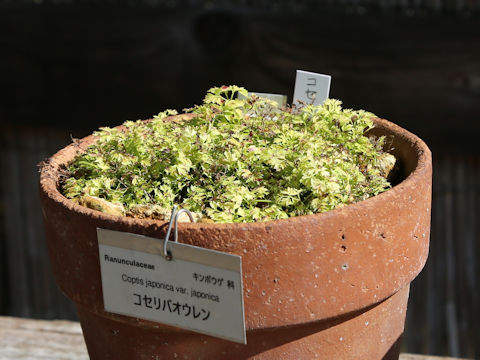
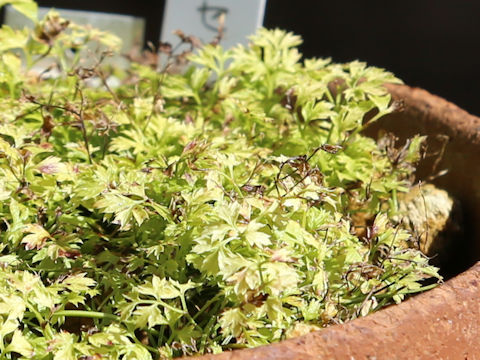
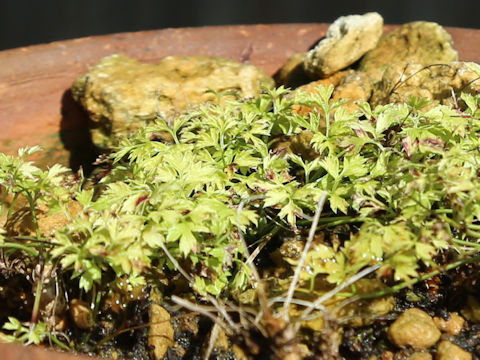
わが国の本州、東北地方南部から近畿地方および四国の太平洋側に分布しています。山地の林内に生え、高さは15~40センチになります。葉は3回3出複葉で薄く、鋭い鋸歯があります。2月から3月ごろ、花茎を伸ばして、茎頂に白色の花を咲かせます。花弁に見える白色は萼片で,中心には淡黄色の雄しべが集まります。雌雄異株まれに雌雄同株です。果実は袋果で、5~10個輪生します。近年では、「きくばおうれん」や「せりばおうれん」の基準種とされています。 |
|
|
キンポウゲ科オウレン属の常緑多年草で、学名は Coptis japonica var. japonica (syn. Coptis japonica var. major)。英名はありません。 |
|
|
The "Ko-seriba-ohren" (Coptis japonica var. japonica) belongs to Ranunculaceae (the Buttercup family). It is an evergreen perennial herb that is found from the southern part of the Tohoku region to the Kinki region on Honshu and Shikoku, along the Pacific coast. It grows in mountain forests and reaches a height of 15 to 40 cm. The leaves are thin, three-times-ternate compound leaves with sharp serrations. From around February to March, it extends a flower stalk and produces white flowers at the tip of the stem. The white parts that appear to be petals are actually sepals, and pale yellow stamens cluster at the center. The plant is dioecious, though it is rarely monoecious. The fruit is a capsule, with 5 to 10 fruits arranged in a whorl. In recent years, it has been recognized as the type species for "Kikuba-ohren" and "Seriba-ohren". |
|
|
北海道札幌市中央区「北海道大学植物園」にて、2026年09月30日撮影。 |
|
|

|
Shu Suehiro shu@botanic.jp
|
|