
|

|
 こうしゅんうまのすずくさ (恒春馬の鈴草)
|
[Index]
[Back]
|
|
|
     |
|

|
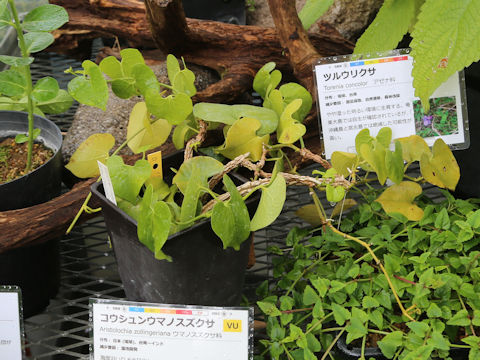
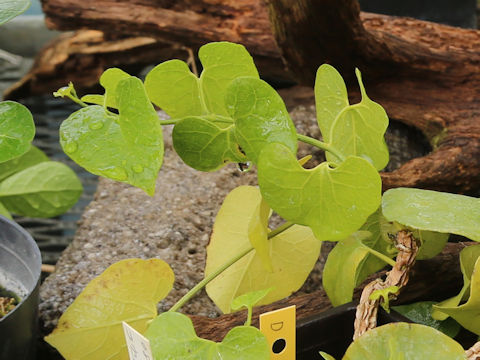
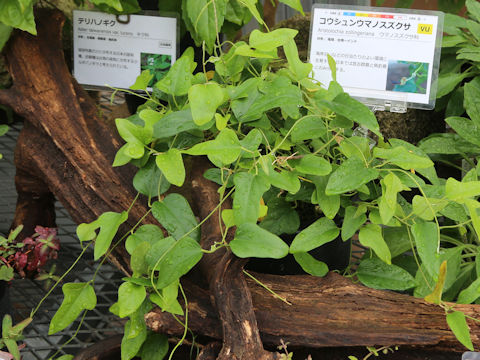
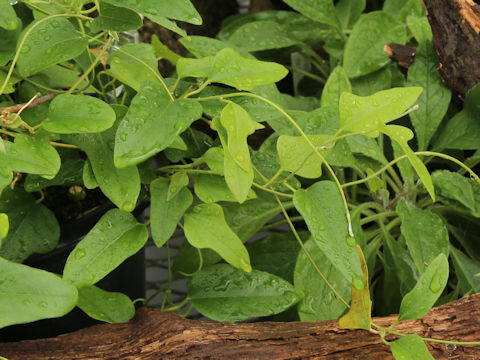
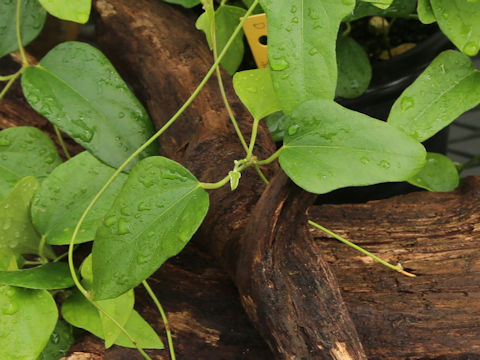
わが国の宮古諸島および尖閣諸島、それに台湾や中国南部,フィリピン,マレーシア,インドに分布しています。海岸や低地の明るい林縁部に生え、蔓性で長さは5メートルほどになります。葉は三角状卵形から菱形状心形で革質、表面には光沢があり、互生します。6月から8月ごろ、葉腋に淡緑色から淡褐色の花を咲かせます。果実は倒卵状球形の蒴果です。ジャコウアゲハやベニモンアゲハの食草です。環境省のレッドリストでは絶滅危惧II類(VU)に指定されています。台湾華語では「港口馬兜鈴」、中国語では「港口馬兜鈴(gang kou ma dou ling)」と呼ばれます。台湾華語の「港口馬兜鈴」は、恆春半島の「港口」で最初に発見されたことで名付けられました。 |
|
|
ウマノスズクサ科ウマノスズクサ属の多年草で、学名は Aristolochia zollingeriana。英名は Gang-kou birthwort、Gang-kou pipevine。 |
|
|
The Gang-kou birthwort (Aristolochia zollingeriana) belongs to Aristolochiaceae (the Birthwort family). It is a perennial herb that is distributed throughout Japan's Miyako Islands and the Senkaku Islands, as well as in Taiwan, southern China, the Philippines, Malaysia, and India. It grows along coastlines and in sunny forest edges in lowland areas; it is a vine that can reach a length of about 5 m. The leaves are leathery, ranging in shape from triangular-ovate to rhomboid-cordate, with a glossy surface, and are arranged alternately. From June to August, it produces pale green to pale brown flowers in the leaf axils. The fruit is an obovate-globose capsule. It serves as a food plant for the Chinese windmill and the Common Rose. It is designated as Vulnerable (VU) on the Ministry of the Environment's Red List. In Taiwanese Chinese, it is called "港口馬兜鈴", and in Chinese, it is known as "港口馬兜鈴" (gang kou ma dou ling). The Taiwanese Chinese "港口馬兜鈴" was given because it was first discovered in "Gang-kou" on the Hengchun Peninsula. |
|
|
茨城県つくば市「つくば実験植物園」にて、2026年03月28日撮影。 |
|
|

|
Shu Suehiro shu@botanic.jp
|
|