
|
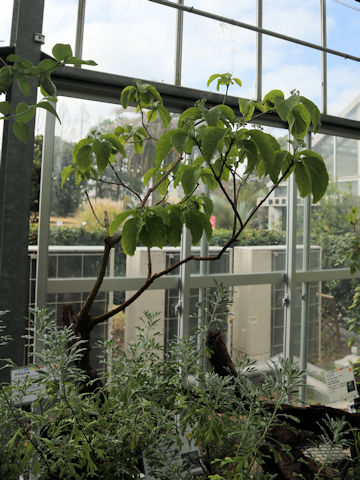
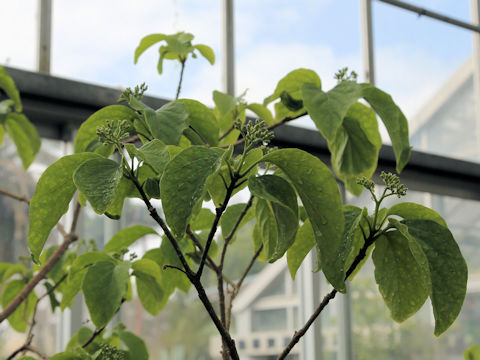
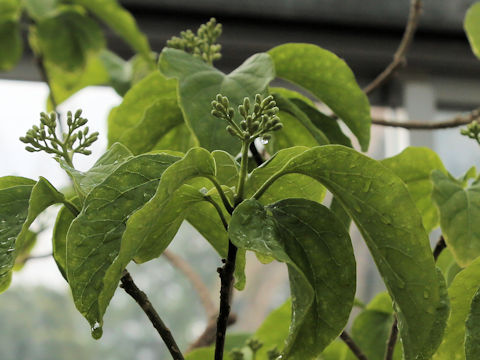
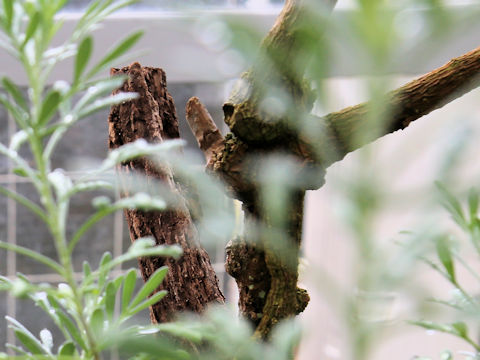
The "Kusa-mizuki" (Nothapodytes insularis) belongs to Icacinaceae (the White pear family). It is a semi-tall evergreen tree that is distributed across Iriomote Island, Ishigaki Island, and Yonaguni Island in Japan's Yaeyama Islands, as well as on Green Island and Lanyu in Taiwan. It grows within and along the edges of coastal forests, reaching a height of 5 to 15 m. The bark is grayish-white, with numerous lenticels clearly visible on the surface. The leaves are obovate-elliptic to elliptic, arranged alternately, and have entire margins. From February to April, it produces panicles at the tips of its branches, bearing small, pale green hermaphroditic flowers. The fruit is an elliptical drupe that ripens to a purplish-black color. Its Japanese name derives from the distinctive odor of its leaves and flowers. Because the wood and leaves of this species contain the alkaloid Camptothecin, it serves as a source plant for the anticancer drug Irinotecan. It is designated as Endangered (EN) in Category IB on the Ministry of the Environment's Red List. In Taiwanese Chinese, it is called "青脆枝".
This species was previously considered the same as "Stinking tree" (Nothapodytes nimmonianus), which is distributed from India to Sri Lanka and Southeast Asia; however, molecular phylogenetic analysis conducted by Yu Ito and colleagues at Setsunan University in 2022 revealed that specimens from the Ryukyu Islands and Taiwan constitute a separate species.
|


 くさみずき (臭水木)

 shu@botanic.jp