
|
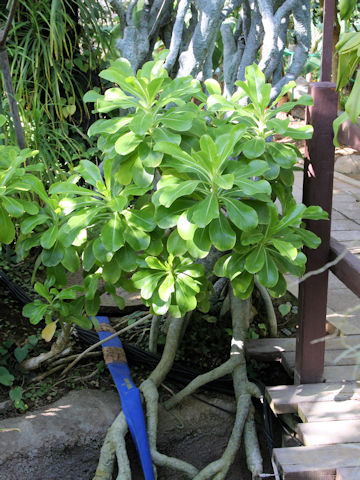
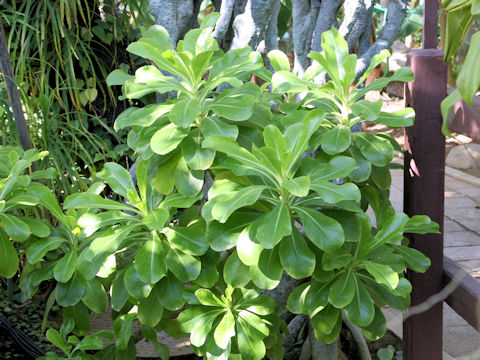
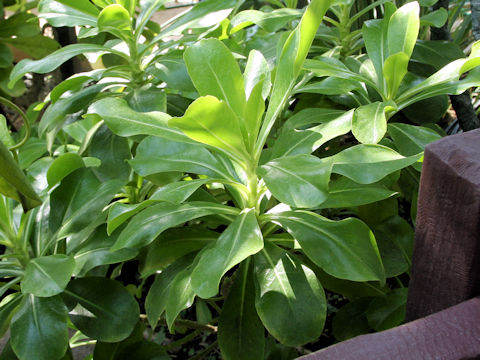
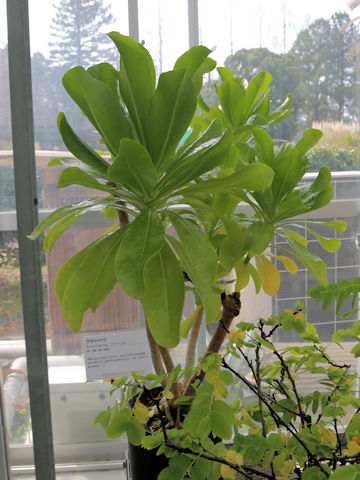
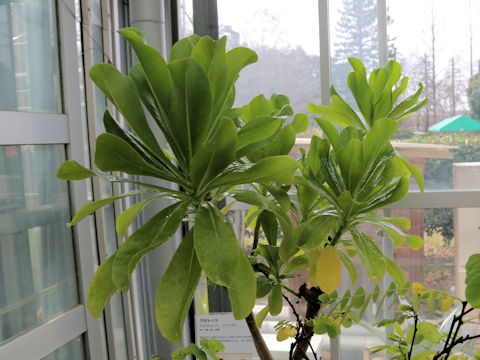
The Beach naupaka (Scaevola taccada) belongs to Goodeniaceae (the Naupaka family). It is an evergreen shrub that is widely distributed throughout Japan's Nansei Islands and Ogasawara Islands, as well as in tropical and subtropical regions stretching from the Pacific to the Indian Ocean. It grows along or near coastlines and reaches a height of 1 to 2 m. The leaves are oblong-lanceolate, about 10 to 15 cm long, leathery, and arranged in an alternate pattern at the tips of the stems. The leaves resemble those of the "Monpa-no-ki" (Argusia argentea), but are characterized by their yellow-green color and sparse hairiness. In Japan, from around June to August, and year-round in subtropical and tropical regions, the plant produces cymose inflorescences from the leaf axils, bearing white flowers with purple veins. The flowers have five petals with wavy edges, and their color gradually changes from white to yellow. The fruit is an elliptical drupe that ripens to a white color. There is interindividual variation in this species between a "cork type", which has a fruit with a cork layer that floats on water and a fleshy layer eaten by birds, and a "pulp type", which has a fruit with only the fleshy layer. According to Naoko Emura of Kagoshima University, the cork type is dispersed by ocean currents and animals, while the pulp type is dispersed by animals. Both forms are widely distributed within the species' range, with the cork type dominating on sandy beaches and the pulp type on sea cliffs. It is called "草海桐" in Taiwanese Chinese and "草海桐" (cao hai tong) in Chinese.
|


 くさとべら (草海桐)

 shu@botanic.jp