
|
|
|

|
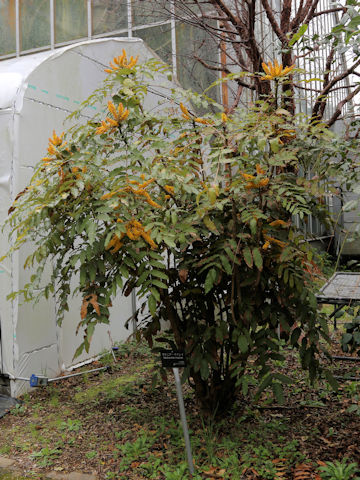
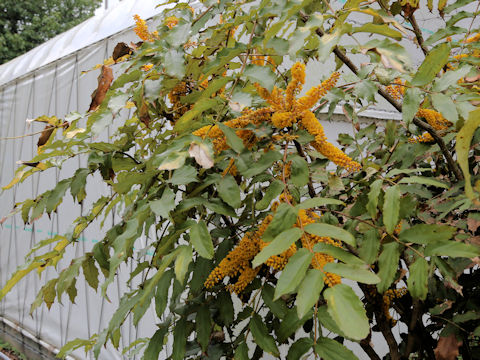
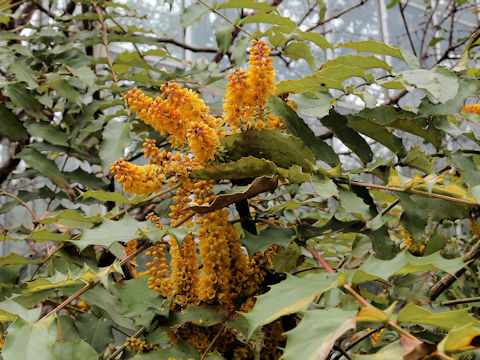
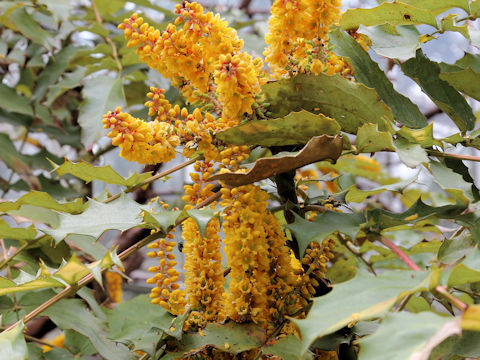
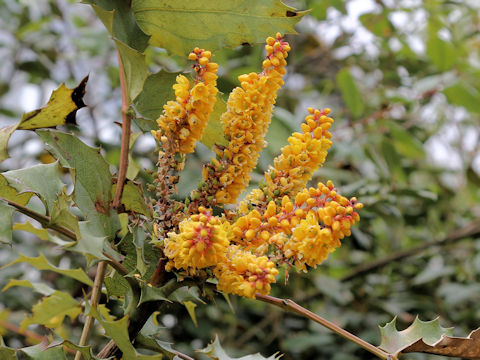
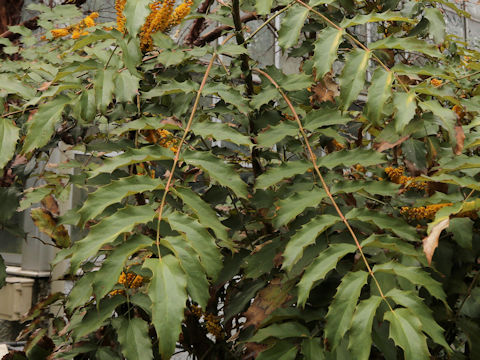
中国の中南部、四川省から雲南省、広西壮族自治区、それにタイ、ビルマ、インドに分布しています。標高1800~2700メートルにある森林や低木林などに生え、高さは1.5~4メートルになります。葉は奇数羽状複葉で、狭卵形から長楕円状卵形、楕円状披針形の小葉が4~9対あります。小葉の縁には3~12個の鋸歯があります。11月から4月ごろ、茎頂に総状花序の束をだし、黄色の花を咲かせます。果実は液果で、3月から6月ごろに粉白を帯びた深紫色に熟します。種小名は、フランス人宣教師・植物学者であったフランソワ・デュクルー(1864-1945)に因みます。中国語では「長柱十大功勞(chang zhu shi da gong lao)」と呼ばれます。
|
|
|
メギ科ヒイラギナンテン属の常緑低木で、学名は Mahonia duclouxiana (syn. Mahonia mairei, Berberis napaulensis var. napaulensis)。英名はありません。
|
|
|
The Mahonia duclouxiana belongs to Berberidaceae (the Barberry family). It is a small evergreen tree that is distributed to central-southern China, from Sichuan Province to Yunnan Province and the Guangxi Zhuang Autonomous Region, as well as in Thailand, Burma, and India. It grows in forests and shrublands at elevations of 1800 to 2700 m and reaches a height of 1.5 to 4 m. The leaves are odd-pinnate compound leaves, with 4 to 9 pairs of leaflets ranging in shape from narrowly ovate to oblong-ovate or elliptic-lanceolate. The margins of the leaflets have 3-12 teeth. From November to around April, it produces clusters of racemose inflorescences at the stem tips, bearing yellow flowers. The fruit is a berry that ripens to a deep purple with a powdery white tinge from March to around June. The specific epithet honors François Ducruet (1864-1945), a French missionary and botanist. In Chinese, it is known as "長柱十大功勞" (chang zhu shi da gong lao).
|
|
|
茨城県つくば市「つくば実験植物園」にて、2026年03月28日撮影。
|
|
|
|
|

 マホニア・デュクルーシアナ

 shu@botanic.jp