
|
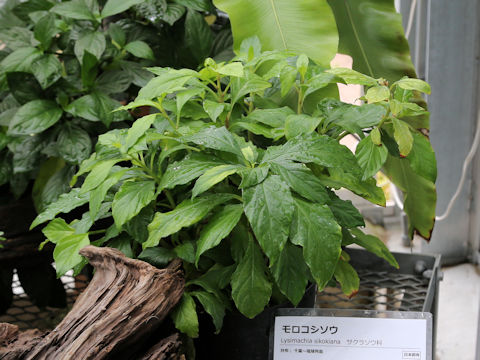
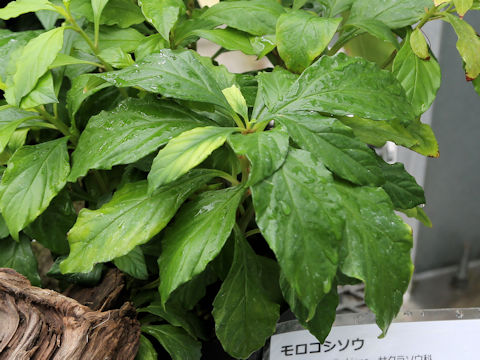
The "Morokoshi-so" (Lysimachia sikokiana) belongs to Primulaceae (the Primrose family). It is a perennial herb that is endemic to Japan and is found from the southern part of the Kanto region on Honshu southward, as well as in Shikoku, Kyushu, the Nansei Islands, and the Ogasawara Islands. It grows in lowlands near the sea in warm regions, as well as within and along the edges of forests in mountainous areas, reaching a height of 20 to 80 cm. The stem is erect or ascending and branches. The leaves are ovate and glossy, with wavy margins, and are arranged alternately. From June to September, yellow flowers hang downward from the upper leaf axils. The fruit is a spherical capsule that ripens to a grayish-white color. This species is a traditional insect-repelling and aromatic plant that has long been cherished in Okinawa. Its Japanese name derives from the fact that it was once mistakenly believed to be a plant introduced from China in ancient times. It is also known by the alternative name "Yama-kunenbo", which stems from the fact that it grows in the mountains and its scent resembles that of "Kunenbo" (King tangor), a plant in the citrus family.
|


 もろこしそう (唐土草)

 shu@botanic.jp