
|

|
 むかしべにしだ (昔紅羊歯)
|
[Index]
[Back]
|
|
|
    |
|

|
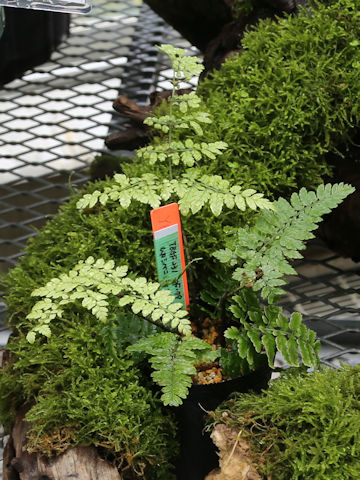
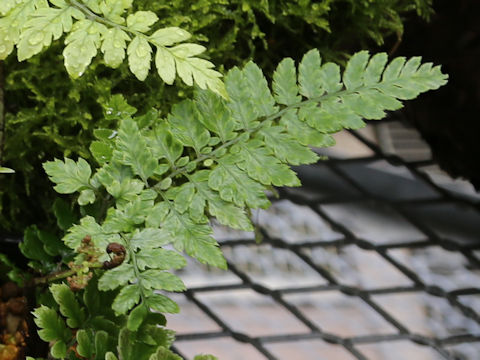
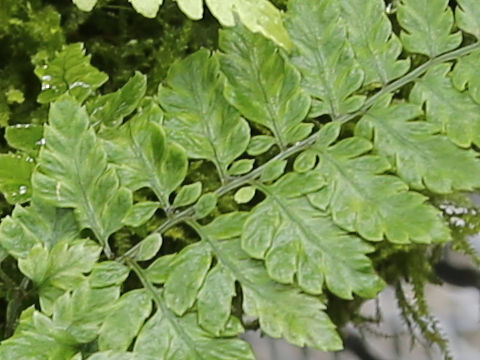
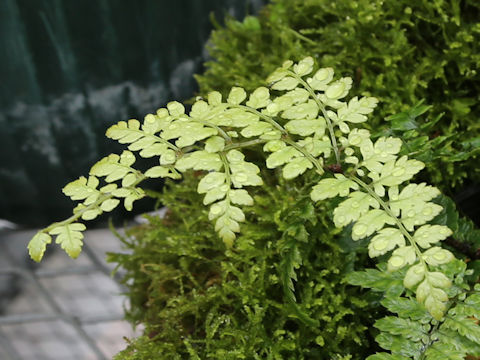
わが国の鹿児島県にある屋久島の固有種です。渓流に近い林内に生え、高さは30センチほどになります。葉は三角状の2~3回羽状複葉で、長さは50センチ、幅は20センチほどになります。ふつうのベニシダ類とは異なり、成長しても、小羽片や葉脈が内先分岐(注1)をするのが特徴です。(ふつうのベニシダ類は、前葉体から生えた幼植物では内先分岐になりますが、成長にしたがって外先分岐(注2)に変化します。)和名は、「今のベニシダとは違う、昔の性質を持った」という意味で名付けられました。環境省のレッドブックでは絶滅危惧IA類(CR)に分類されています。 ※注1: 内先分岐は、羽片や小羽片、葉脈が最初に内側(上向き)に分岐をする形式。 ※注2: 外先分岐は、羽片や小羽片、葉脈が最初に外側(下向き)に分岐をする形式。 |
|
|
オシダ科オシダ属の常緑シダ類で、学名は Dryopteris anadroma。英名はありません。 |
|
|
The "Mukashi-beni-shida" (Dryopteris anadroma) belongs to the family Dryopteridaceae. It is an evergreen fern that is an endemic species found on Yakushima Island in Kagoshima Prefecture, Japan. It grows in forests near mountain streams and reaches a height of about 30 cm. Its leaves are triangular, 2-3 times pinnately compound, and measure about 50 cm in length and 20 cm in width. Unlike typical Autumn fern (Dryopteris erythrosora), it is characterized by the fact that even as it matures, its small pinnae and leaf veins continue to Anadromous pattern (Note 1). (In typical Autumn fern, young plants growing from the prothallus exhibit Anadromous pattern, but this changes to Catadromous pattern (Note 2) as they mature.) Its Japanese name was given to signify that it possesses the characteristics of Autumn fern from the past, unlike modern ones. It is classified as Critically Endangered (CR) in the Ministry of the Environment's Red List. *Note 1: Anadromous pattern refers to a form in which the first vein produced faces inward (upward). *Note 2: Catadromous pattern refers to a form in which the first vein branches towards the base of the frond (outward, downward). |
|
|
茨城県つくば市「つくば実験植物園」にて、2026年03月28日撮影。 |
|
|

|
Shu Suehiro shu@botanic.jp
|
|