
|

|
 むしゃしだ (霧社羊歯)
|
[Index]
[Back]
|
|
|
    |
|

|
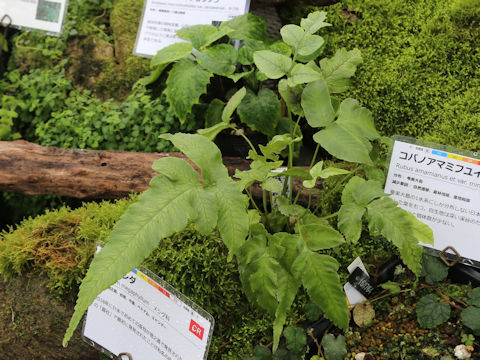
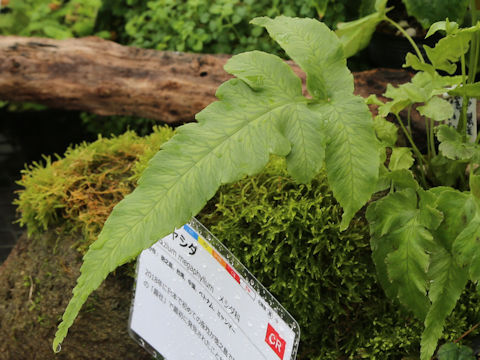
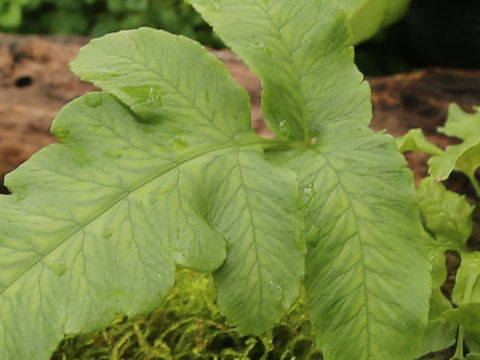
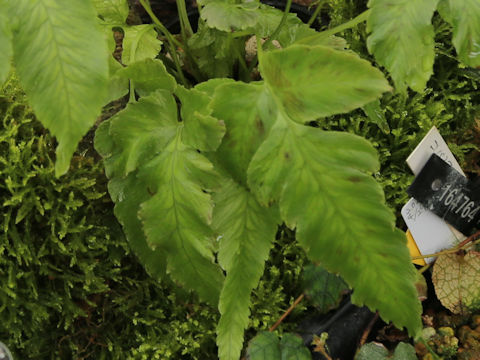
わが国の奄美群島の徳之島、それに台湾や中国南部、ベトナム北部、ビルマ東部に分布しています。わが国では、2018年に徳之島で発見されました。主に石灰質地域の渓谷や小川のほとりに生え、高さは90~150センチになります。根茎は太くて直立し、褐色で、直径2センチほどです。葉は1回羽状複葉で長楕円形、長さは50~90センチあり、基部は主に羽状深裂して、先端は三角形です。側小葉は7~9対あります。胞子嚢群は線形で、葉脈の中央部または基部に位置します。和名は台湾南投県の霧社に因みます。環境省のレッドリストでは、絶滅危惧IA類(CR)に分類されています。台湾華語では「大葉雙蓋蕨」、中国語では「大羽雙蓋蕨(da yu shuang gai jue)」と呼ばれます。 |
|
|
イワデンタ科ヘラシダ属の常緑性シダで、学名は Diplazium megaphyllum。英名はありません。 |
|
|
The "Musha-shida" (Diplazium megaphyllum) belongs to the family Woodsiaceae. It is an evergreen fern that is distributed on Tokunoshima Island in Japan's Amami Islands, as well as in Taiwan, southern China, northern Vietnam, and eastern Burma. In Japan, it was discovered on Tokunoshima Island in 2018. It grows primarily along the banks of streams and in valleys in limestone regions, reaching a height of 90 to 150 cm. The rhizome is thick and erect, brown in color, and about 2 cm in diameter. The leaves are once-pinnately compound and oblong, 50-90 cm long, with the base typically deeply pinnately lobed and the apex triangular. There are 7-9 pairs of lateral leaflets. The sori are linear and located along the central part or at the base of the leaf veins. Its Japanese name is derived from Wushe in Nantou County, Taiwan. It is classified as Critically Endangered (CR) on the Ministry of the Environment's Red List. In Taiwanese Chinese, It is called "大葉雙蓋蕨", and "大羽雙蓋蕨" (da yu shuang gai jue) in Chinese. |
|
|
茨城県つくば市「つくば実験植物園」にて、2026年03月28日撮影。 |
|
|

|
Shu Suehiro shu@botanic.jp
|
|