
|

|
 ラペイロージア・オレオゲナ
|
[Index]
[Back]
|
|
|
   |
|

|
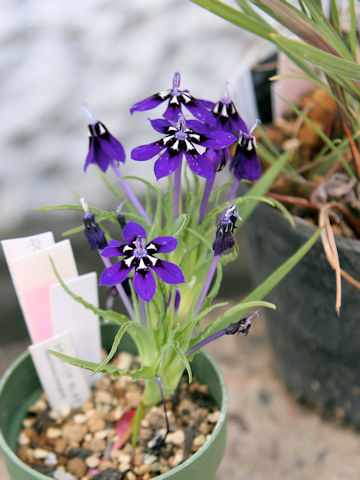
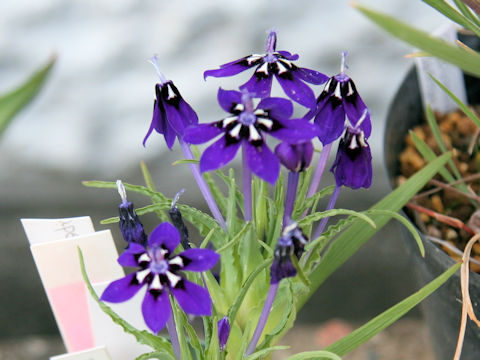
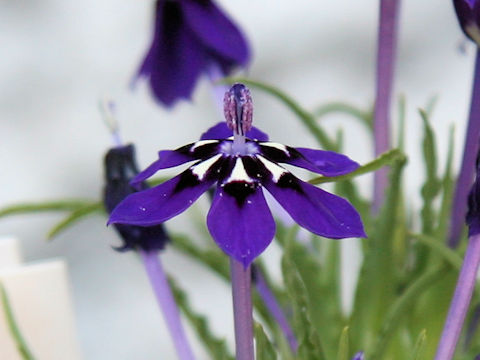
南アフリカの北ケープ州と西ケープ州に分布しています。低地や斜面にある粘土質の低木地、草地に生え、高さは10センチほどになります。球茎から披針形の葉をだします。8月から9月ごろ、地面の高さに、らせん状の穂状花序をだし、紫色の花を咲かせます。花被片は6個あり、基部には長さ5~6センチの長い花被筒があります。また花被片基部には内輪状に黒色から濃紫色の斑紋があり、花冠筒の入口方向を向く6個のクリーム色の矢じり状の模様があります。これらの斑紋は機能的な蜜標として働きます。この植物は特殊な長吻のハエによって受粉されます。このハエは非常に長く硬い口吻(約4センチ)があり、花の長い花冠筒内の蜜に到達することができます。 |
|
|
アヤメ科ラペイロージア属の多年草で、学名は Lapeirousia oreogena。英名は Cushion cabong。 |
|
|
The Cushion cabong (Lapeirousia oreogena) belongs to Iridaceae (the Iris family). It is an evergreen perennial herb that is distributed in the Northern Cape and Western Cape provinces of South Africa. It grows in clayey scrublands and grasslands on lowlands and slopes, reaching a height of about 10 cm. It produces lanceolate leaves from its bulb. From August to September, it produces a spiral-shaped spike inflorescence at ground level, bearing purple flowers. It has six perianth segments, with a long perianth tube at the base measuring 5 to 6 cm in length. Additionally, the base of the perianth segments features inner-ring-like black to deep purple markings and six cream-colored arrowhead-shaped patterns oriented toward the entrance of the corolla tube. These markings function as functional nectaries. This plant is pollinated by specialized long-tongued flies. These flies possess an exceptionally long, rigid proboscis (approximately 4 cm) enabling them to reach nectar within the flower's long corolla tube. |
|
|
茨城県つくば市「つくば実験植物園」にて、2026年03月07日撮影。 |
|
|

|
Shu Suehiro shu@botanic.jp
|
|