
|

|
 らんだいみず (巒大みず)
|
[Index]
[Back]
|
|
|
     |
|

|
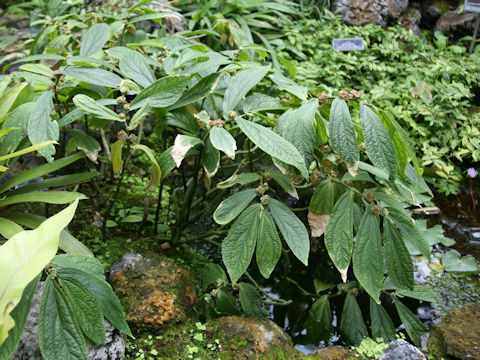
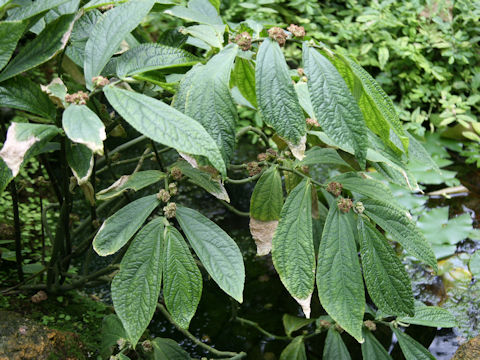
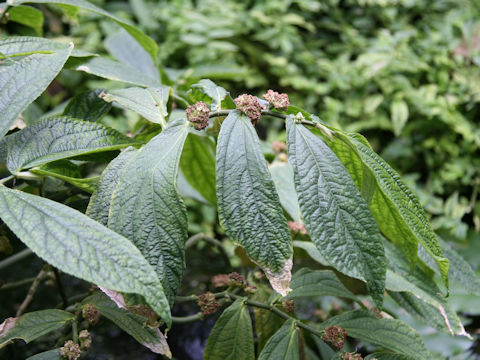
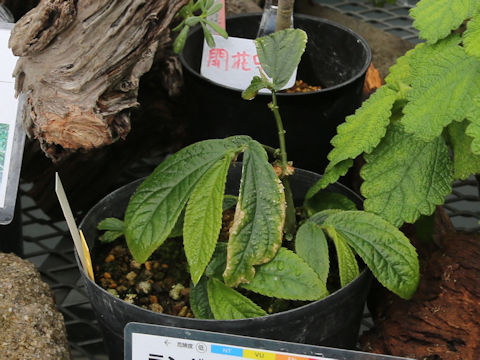
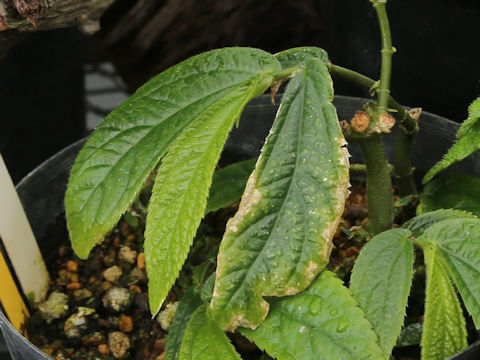
わが国の八重山諸島、西表島から台湾、中国の南部それにヒマラヤ周辺に分布しています。山地の川沿いなどに生え、高さは50~100センチになります。茎は直立し、よく分枝します。葉は歪な長楕円形から狭楕円形で互生し、縁には細かい鋸歯があります。4月から6月ごろ、葉腋に花を咲かせます。雌雄異株で、雄花序は集散花序、雌花序は小形で単生します。西表島は分布の北限で、環境省のレッドリストでは絶滅危惧IB類(EN)に分類されています。和名は、台湾南投県にある「巒大山」に因みます。台湾華語では「巒大冷清草」、中国語では「寬葉楼梯草(kuan ye lou ti cao)」と呼ばれます。 |
|
|
イラクサ科ウワバミソウ属の多年草で、学名は Elatostema platyphylloides (syn. Elatostema platyphyllum)。英名はありません。 |
|
|
The "Randai-mizu" (Elatostema platyphylloides) belongs to Urticaceae (the Nettle family). It is a perennial herb that is distributed from Iriomote Island in the Yaeyama Islands of Japan to Taiwan, southern China, and the Himalayan region. It grows along mountain rivers and reaches a height of 50 to 100 cm. The stem is erect and branches profusely. The leaves are distorted elliptic to narrow elliptic, alternate, and have fine serrations on the margins. Flowers bloom in the leaf axils from April to June. It is dioecious, with male inflorescences in cymes and female inflorescences small and solitary. Iriomote Island is the northern limit of its distribution, and it is classified as Endangered (EN) on the Red List of the Ministry of the Environment. The Japanese name comes from the "巒大山" (Luandai shan) in Nantou County, Taiwan. It is called "巒大冷清草" in Taiwanese Chinese and "寬葉楼梯草" (kuan ye lou ti cao) in Chinese. |
|
|
[上・中1~2] 富山市婦中町「富山県中央植物園」にて、2025年03月21日撮影。 [中3・下] 茨城県つくば市「つくば実験植物園」にて、2026年03月28日撮影。 |
|
|

|
Shu Suehiro shu@botanic.jp
|
|