
|

|
 さだそう (佐多草)
|
[Index]
[Back]
|
|
|
    |
|

|
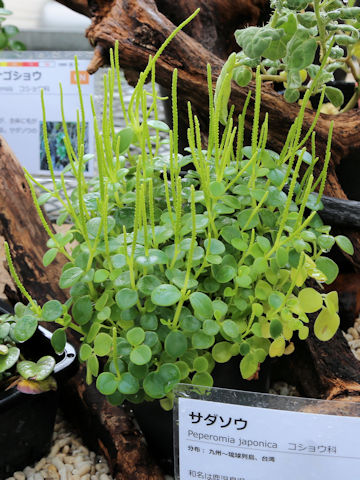
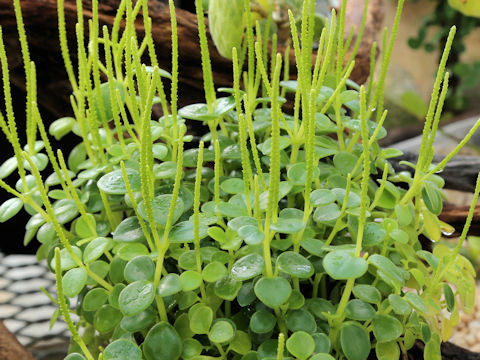
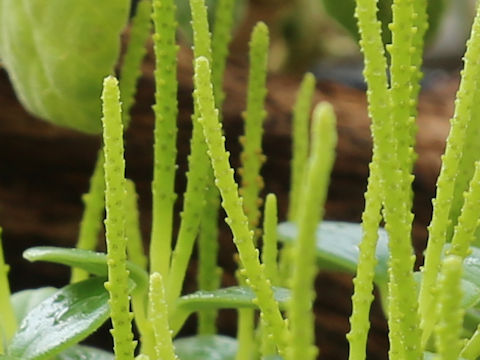
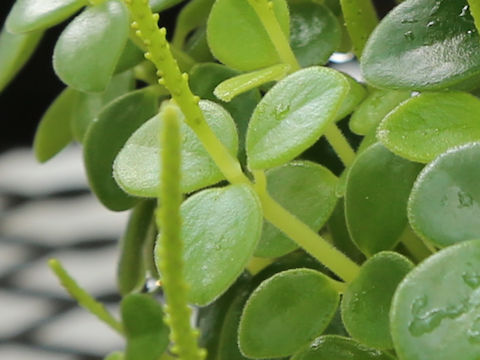
わが国の四国南部、九州南部、南西諸島、それに台湾や中国南部に分布しています。山地から海岸の岩場や石灰岩地に生え、高さは10~40センチになります。茎は円柱状で直立し、叢生します。葉は倒卵形から倒卵状楕円形で、対生または3~5輪生します。おもに5月から10月ごろ、茎の先端または葉腋から、短い肉穂花序をだします。花は小さな両性花です。果実は倒卵状球形の液果です。和名は、鹿児島県大隅半島の佐多岬で発見されたことに由来します。台湾華語では「椒草」、中国語では「石蝉草(shi chan cao)」と呼ばれます。 |
|
|
コショウ科サダソウ属の常緑多年草で、学名は Peperomia japonica (syn. Peperomia formosana、Peperomia blanda)。英名はありません。 |
|
|
The "Sada-so" (Peperomia japonica) belongs to Piperaceae (the Pepper family). It is an evergreen perennial herb that is distributed from southern Shikoku, southern Kyushu, and the Nansei Islands in Japan, as well as in Taiwan and southern China. It grows in mountainous areas, on coastal rocky outcrops, and in limestone regions, reaching a height of 10 to 40 cm. The stems are cylindrical, erect, and grow in clumps. The leaves are obovate to obovate-elliptic, arranged in opposite pairs or in whorls of 3 to 5. Primarily from May to October, short, fleshy spikes emerge from the tips of the stems or from the leaf axils. The flowers are small and hermaphroditic. The fruit is an obovate-globose berry. Its Japanese name derives from the fact that it was discovered at Cape Sata on the Osumi Peninsula in Kagoshima Prefecture. It is called "椒草" in Taiwanese Chinese and "石蝉草" (shi chan cao) in Chinese. |
|
|
茨城県つくば市「つくば実験植物園」にて、2026年03月28日撮影。 |
|
|

|
Shu Suehiro shu@botanic.jp
|
|