
|

|
 せいようおかひじき (西洋陸鹿尾菜)
|
[Index]
[Back]
|
|
|
     |
|

|
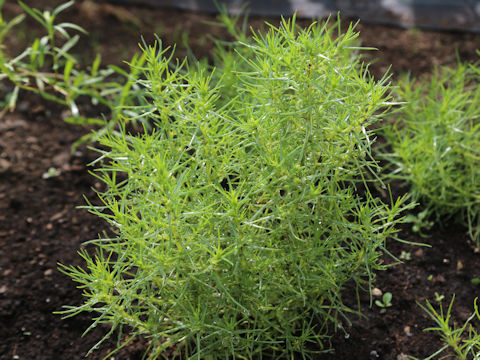
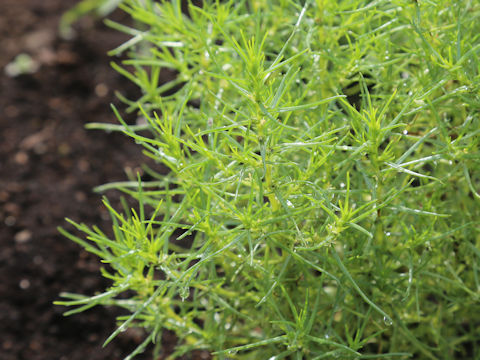
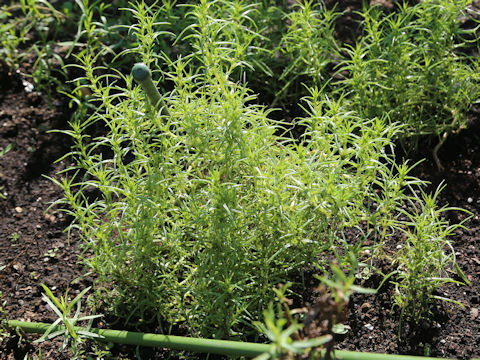
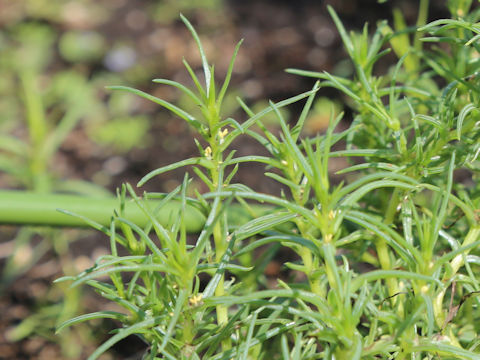
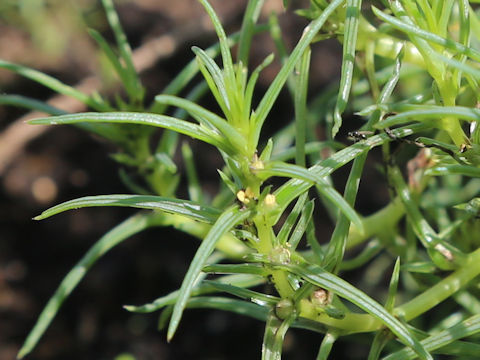
地中海沿岸から中央および西南アジア、中国の新疆ウイグル自治区に分布しています。塩湖の湖岸や、塩分を含む土壌の草原などに生え。高さは70センチほどになります。茎は緑色または赤色をしています。葉は線形で緑色、多肉質、そして対生します。6月から8月ごろ、葉腋に目立たない白色から薄緑色の花を咲かせます。果実は、直径3~6ミリの小さな袋果です。ギリシャ語ではアルミラ、イタリア語ではアグレッティなどと呼ばれます。 「せいようおかひじき」には、ビタミンAやカリウム、カルシウム、鉄分などの栄養素が豊富で、シャキシャキとした食感と微かな塩気が特徴のヘルシーな野菜です。若い葉は生のままでサラダに、熱湯で1~2分ほど茹でて、お浸し、酢の物や和え物などに利用できます。中国語では「蘇打猪毛菜(su da zhu mao cai)」と呼ばれます。 |
|
|
アカザ科ソーダ属の一年草で、学名は Soda inermis (syn. Salsola soda)。英名は Opposite-leaved saltwort。 |
|
|
The Opposite-leaved saltwort (Soda inermis) belongs to Chenopodiaceae (the Goosefoot family). It is an annual herb that is distributed from the Mediterranean coast to Central and Southwest Asia, and the Xinjiang Uyghur Autonomous Region of China. It grows along the shores of salt lakes and in grasslands with saline soil. It reaches a height of about 70 cm. The stems are green or red. The leaves are linear, green, fleshy, and arranged in opposite pairs. From June to August, it produces inconspicuous white to pale green flowers in the leaf axils. The fruit is a small capsule, 3 to 6 mm in diameter. It is known as "almyra" in Greek and "agretti" in Italian. It is a healthy vegetable rich in nutrients such as vitamin A, potassium, calcium, and iron, characterized by its crisp texture and subtle saltiness. Young leaves can be eaten raw in salads, or blanched in boiling water for 1 to 2 minutes and used in dishes such as simmered greens, vinegar-based salads, or dressed salads. It is called "蘇打猪毛菜" (su da zhu mao cai) in Chinese. |
|
|
[上・中1] 宮城県川崎町支倉にて、2026年08月26日撮影。 [中2~3・下] 同上にて、2026年09月05日撮影。 |
|
|

|
Shu Suehiro shu@botanic.jp
|
|