
|

|
 しこたんよもぎ (色丹蓬)
|
[Index]
[Back]
|
|
|
  |
|

|
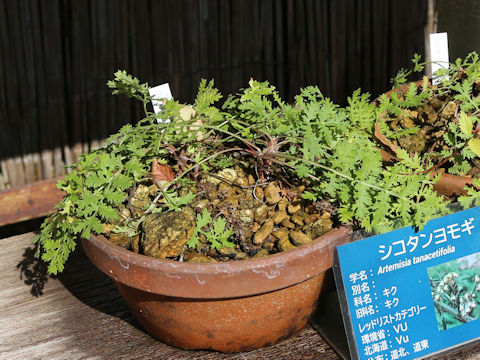
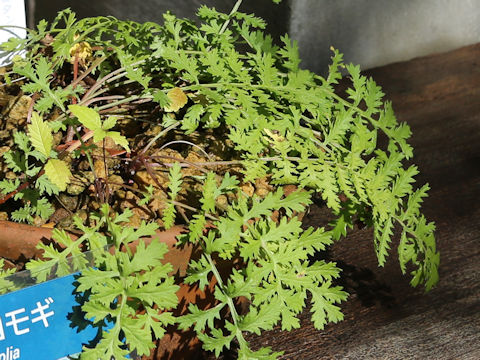
わが国の北海道東部と礼文島・利尻島、それに朝鮮半島北東部から中国北部、ロシア、ヨーロッパ東部、北アメリカ北部に分布しています。海岸沿いの乾燥した草原や岩礫地、高山の風衝地などに生え、高さは30~60センチになります。葉は2回羽状深裂で、細かく切れ込みの多いのが特徴です。8月から9月ごろ、花茎を伸ばして、総状花序に小さな淡黄色の頭花をすずなりに咲かせます。別名で「きくよもぎ(菊蓬)」とも呼ばれます。環境省のレッドリストにおいて絶滅危惧Ⅱ類(VU)に指定されています。中国語では「裂葉蒿(lie ye hao)」と呼ばれます。 韓国語では「クワッスク(구와쑥)」です。これは「クワッ(구와)」+「ヨモギ(スク: 쑥)」の合成語です。葉が菊の葉のように裂ける特徴から「クッカスク(구화쑥)」と呼ばれていたのが、口伝されるうちに「クッカ(菊: 구화)」が「クワッ(桑: 구와)」へと変化したものと考えられています。 |
|
|
キク科ヨモギ属の多年草で、学名は Artemisia tanacetifolia (syn. Artemisia laciniata)。英名は Tansy-leaved wormwood。 |
|
|
The Tansy-leaved wormwood (Artemisia tanacetifolia) belongs to Asteraceae (the Aster family). It is a perennial herb that is found in eastern Hokkaido and on the islands of Rebun and Rishiri in Japan, as well as in the northeastern part of the Korean Peninsula, northern China, Russia, eastern Europe, and northern North America. It grows in dry coastal grasslands, rocky areas, and wind-exposed alpine regions, reaching a height of 30 to 60 cm. Its leaves are twice-pinnately deeply lobed and are characterized by their fine, deeply incised edges. From August to September, it extends a flower stalk and produces small, pale yellow flower heads in racemes that hang in clusters. It is also known by the alternative name "kiku-yomogi" (chrysanthemum mugwort) in Japan. It is designated as "Vulnerable" (VU) on the Ministry of the Environment’s Red List. It is called "裂葉蒿" (lie ye hao) in Chinese. In Korean, it's called "gu-wa-ssuku" (구와쑥). This is a compound word consisting of "gu-wa" (구와) + "wormwood" (ssuku: 쑥). It was originally called "gu-kwa-ssuk" (구화쑥), but it is believed that as the name was passed down orally, "gu-kwa" (chrysanthemum: 구화) evolved into "gu-wa" (mulberry: 구와). |
|
|
北海道札幌市中央区「北海道大学植物園」にて、2026年09月30日撮影。 |
|
|

|
Shu Suehiro shu@botanic.jp
|
|