
|

|
 すずさいこ (鈴柴胡)
|
[Index]
[Back]
|
|
|
       |
|

|
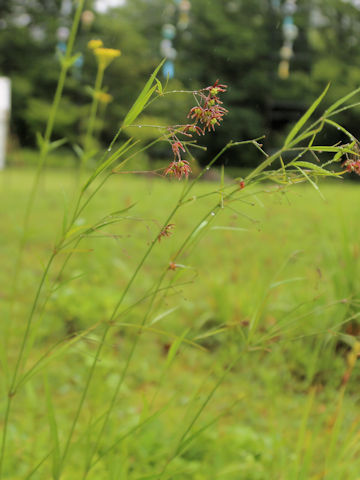
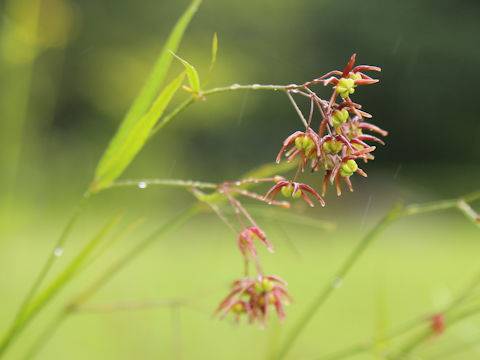
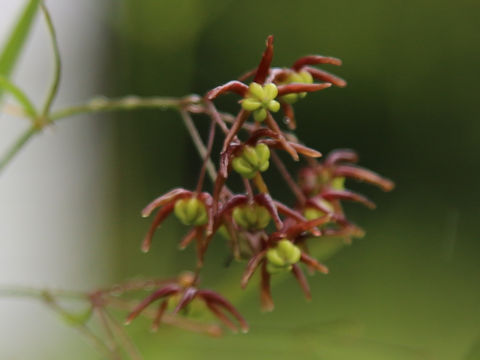
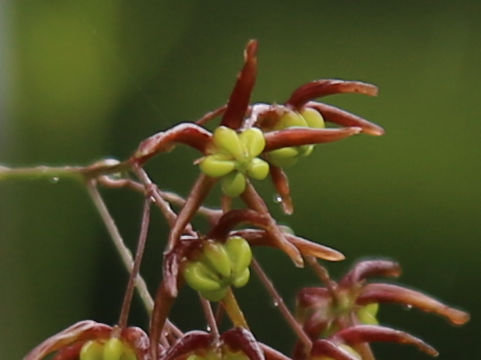
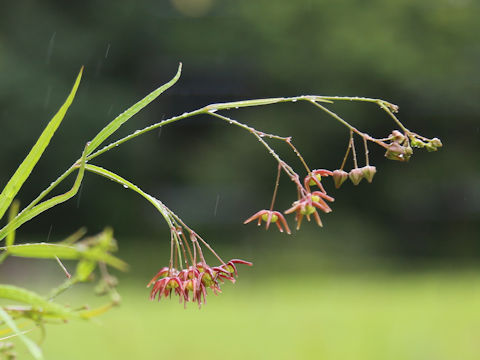
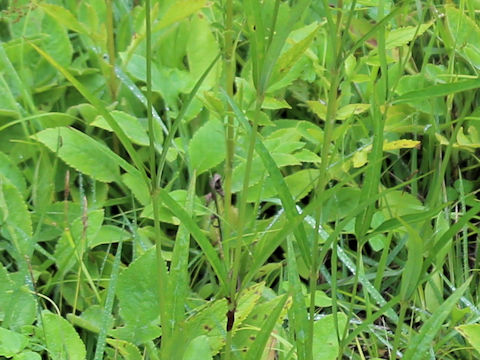
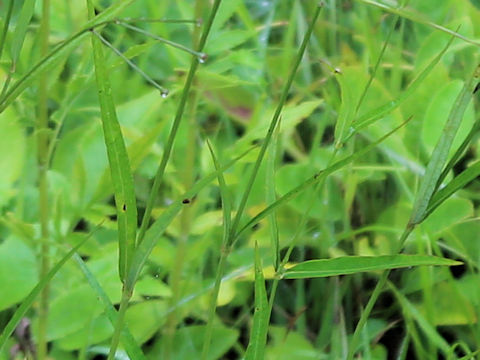
わが国の各地をはじめ、台湾や朝鮮半島、中国、ロシアの極東地方に分布しています。日当たりの良い草地などに生え、高さは40~80センチになります。茎は硬くて細く、ほとんど分枝しません。葉は披針形から線形で対生し、硬い紙質です。また葉は中脈で折れ、V字形となっています。5月から7月ごろ、茎の先端や上部の節に花序をだし、黄色から黄緑色、褐色の花を夜に咲かせます。花冠の裂片は卵形、副花冠は5深裂します。果実は披針形の袋果です。和名は「みしまさいこ(三島柴胡)」に似て、つぼみが鈴のような形をしていることから。台湾華語では「徐長卿」、中国語では「徐長卿(xu chang qing)」と呼ばれます。環境省のレッドリストでは、準絶滅危惧(NT)に分類されています。 |
|
|
ガガイモ科カモメヅル属の多年草で、学名は Cynanchum paniculatum (syn. Vincetoxicum pycnostelma)。英名はありません。 |
|
|
The "Suzu-saiko" (Cynanchum paniculatum) belongs to Asclepiadaceae (the Milkweed family). It is a perennial herb that is distributed throughout Japan, as well as in Taiwan, the Korean Peninsula, China, and the Russian Far East. It grows in sunny grasslands and reaches a height of 40 to 80 cm. The stems are stiff and slender, with almost no branching. The leaves are lanceolate to linear, arranged oppositely, and have a stiff, papery texture. They also bend at the midrib, forming a V-shape. From around May to July, it produces inflorescences at the tips of the stems and at the upper nodes, blooming at night with flowers ranging in color from yellow to yellow-green to brown. The corolla lobes are ovate, and the corona is deeply lobed into five parts. The fruit is a lanceolate capsule. Its Japanese name is derived from its resemblance to "Mishima-saiko" (Bupleurum scorzoneraefolium var. stenophyllum) and the bell-like shape of its buds. In Taiwanese Chinese, it is called "徐長卿", and "徐長卿" (xu chang qing) in Chinese. It is classified as Near Threatened (NT) on the Ministry of the Environment's Red List. |
|
|
宮城県仙台市太白区秋保町馬場「秋保大滝植物園」にて、2026年07月28日撮影。 |
|
|

|
Shu Suehiro shu@botanic.jp
|
|