

|
 ずみ (酸実) |
|
|
|
-- もっと見る(Show more)--
-- 閉じる(Close) --
|
|
|
|

|
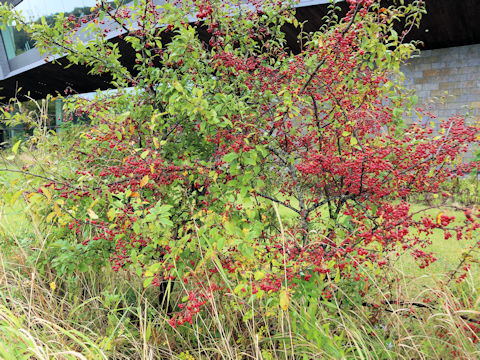
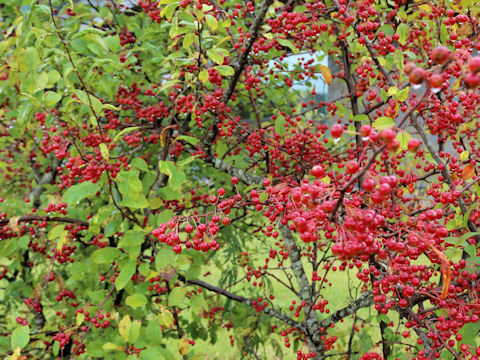
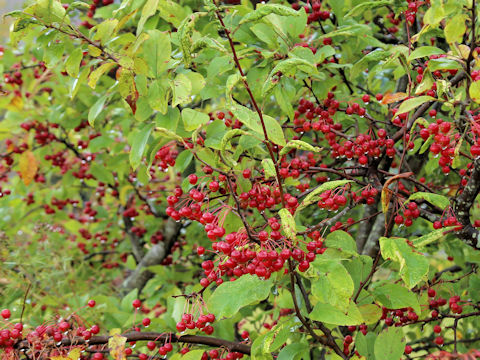
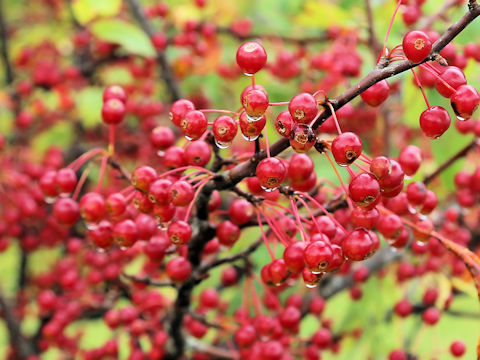
わが国の各地をはじめ、朝鮮半島や中国に分布しています。山野に生え、高さは10メートルほどになります。小枝は堅く、しばしば棘に変わります。葉は楕円形で互生しますが、長枝の葉は3~5裂するものがあります。また若葉の出始めは2つ折りです。4月から6月ごろ、枝先の散形花序に白い花を咲かせます。つぼみの頃は紅色です。花柱はふつう3個、雄しべは多数あります。樹皮からは染料が採れ、その「染(そみ)」が和名の由来です。果実は球形で、9月から10月ごろに橙赤色に熟します。別名には「こりんご(小林檎)」があります。中国語では「三葉海棠(san ye hai tang)」と呼ばれます。 韓国語では「アグベナム(아그배나무)」です。これは果実がとても小さくて「赤ちゃんの梨の木(アギベナム: 아기배나무)」と呼ばれていたのが、時が経つにつれて発音が簡略化され、「アグベナム(아그배나무)」という名前になったそうです。 |
|
|
バラ科リンゴ属の落葉小高木で、学名は Malus toringo (syn. Malus sieboldii)。英名はありません。 |
|
|
The "Zumi" (Malus toringo) belongs to Rosaceae (the Rose family). It is a semi-tall decidous tree that is distributed throughout Japan, as well as the Korean Peninsula and China. This tree grows in hills and fields, and can reach about 10 m in height. The twigs are hard and often turn into spines. The leaves are elliptic and alternate, though they sometimes divided into 3-5 lobes. The browses are twofold when come out in foliation. The white flowers bloom in umbels from April to June. The young buds are tinged rose-pink. The flower has three styles and numerous stamens. The bark yields a dye, from which the Japanese name "somi" (dye) is derived. The fruits are pomes and ripen in orange-red from September to October. It is also known as "Ko-ringo". It is called "三葉海棠" (san ye hai tang) in Chinese. In Korean, it's called "a-gu-bae-na-mu" (아그배나무). This tree was originally called "Baby pear tree" (a-gi-bae-na-mu: 아기배나무), but over time, the pronunciation was simplified, and it came to be known as "a-gu-bae-na-mu" (아그배나무). |
|
|
[上・中1] 栃木県日光市湯元「金精峠」にて、2010年06月27日撮影。 [中2・中5・中7] 長野県安曇野市穂高有明「中房渓谷」にて、2006年06月02日撮影。 [中3] 長野県塩尻市片丘東山にて、2005年05月22日撮影。 [中4] 岐阜県高山市清見町夏厩「小鳥峠」にて、2006年06月01日撮影。 [中6] 長野県大町市八坂「唐花見湿原」にて、2006年06月02日撮影。 [中8・中9] 茨城県つくば市「つくば実験植物園」にて、2009年11月15日撮影。 [中10] 群馬県富士見村「覚満淵」にて、2010年10月02日撮影。 [中11] 京都府宇治市「宇治市植物公園」にて、2005年10月22日撮影。 [中12・中13] 福島県昭和村「駒止湿原」にて、2012年08月26日撮影。 [中14~中17] 長野県茅野市北山にて、2014年05月04日撮影。 [中18~中21] 福島県北塩原村「雄国沼」にて、2014年06月15日撮影。 [中22~中24] 群馬県片品村「尾瀬ヶ原」にて、2015年07月05日撮影 [中25~中35] 長野県小海町豊里にて、2018年05月18日撮影。 [中36~中41] 長野県小海町千代里にて、2018年05月18日撮影。 [中42~中45] 長野県小海町稲子にて、2018年05月18日撮影。 [中46~48・下] 北海道白老町若草町「ウポポイ」にて、2026年10月01日撮影。 |


|
|

|
Shu Suehiro shu@botanic.jp |